


Thanksgiving for Being Chosen as God’s Battle-Ax
Thank God for the Privilege of Being Chosen as God’s Battle-Ax
Today, we will thank God for the privilege for being chosen as God’s battle-ax. One of the greatest privileges in a believer’s life is being called by God and entrusted with a purpose in His kingdom. We should never take this privilege for granted. Every opportunity to serve Him, proclaim His Word, encourage others, advance the gospel, and participate in His work is a reason to give thanks.
Jeremiah 51:20 uses the powerful imagery of a battle-ax and weapons of war. In the context of that prophecy, God describes an instrument through which His purposes of judgment are carried out. While the passage has a specific historical setting, its imagery can prompt Christians to reflect on an important spiritual truth: God can choose, prepare, and use people as instruments to accomplish His purposes.
This is not a declaration that believers are called to fight human beings with physical weapons. The New Testament teaches that our struggle is not against flesh and blood (Ephesians 6:12), and that the weapons of our warfare are not carnal (2 Corinthians 10:3–5). For Christians, this imagery points toward faithful service, spiritual resistance to evil, the proclamation of truth, and obedience to God’s will.
Therefore, when we consider the privilege of being chosen as God’s instruments, our first response should be thanksgiving. We did not create God’s purpose, earn His grace, or make ourselves indispensable to Him. We are recipients of His mercy and stewards of the assignments He entrusts to us.
Let us examine biblical examples of people God called and used, and discover why we should continually thank Him for the privilege of being chosen.
What Does It Mean to Be Chosen by God?
Being chosen by God means that He calls people according to His purposes and entrusts them with responsibilities within His plan. In Scripture, God’s calling takes different forms. He calls some people to leadership, others to prophetic ministry, others to proclaim the gospel, and all believers to live holy lives and serve Him faithfully.
Jesus told His disciples in John 15:16 that He had chosen and appointed them to bear fruit. This reminds us that divine calling is not merely a position of honour; it carries a responsibility to produce fruit that glorifies God.
Ephesians 2:10 teaches that believers are God’s workmanship, created in Christ Jesus for good works that God prepared for them to walk in. Consequently, being chosen should produce humility, gratitude, obedience, and a willingness to serve.
We must also understand that the biblical statement, “many are called, but few are chosen,” appears in Matthew 22:14 at the conclusion of the Parable of the Wedding Feast. It should be read in that context rather than treated as a universal formula for measuring the spiritual worth of everyone selected for a task.
The important lesson for this thanksgiving is simple: whenever God entrusts us with an assignment, we should recognize the privilege, honour the One who called us, and faithfully fulfil the responsibility.
Why should we thank God for choosing us?
We should thank God because:
- His calling reminds us that our lives can serve a purpose greater than our personal ambitions.
- His grace gives us opportunities we could never claim as achievements of our own.
- His empowerment enables us to serve beyond our natural limitations.
- His Word provides direction for fulfilling our assignments.
- His faithfulness sustains us as we grow in maturity and obedience.
Thanksgiving keeps our attention on the Giver rather than allowing us to become consumed by the significance of the assignment.
Gideon’s Three Hundred: Thank God for His Sovereign Choice
Bible passage: Judges 7:1–22
Gideon’s encounter with the Midianites provides a powerful example of God’s ability to accomplish His purposes through a seemingly inadequate number of people.
When Gideon assembled his army, 32,000 men were present. God told him that the number was too large because Israel might boast that its own strength had delivered it. After 22,000 fearful men departed, 10,000 remained. God then reduced the group further until Gideon had 300 men for the mission.
The reduction was not a celebration of human weakness for its own sake. It was designed to demonstrate that Israel’s victory depended on God rather than numerical superiority.
From a human perspective, 300 men facing a large enemy force seemed like an impossible arrangement. Yet God gave Gideon instructions, and the victory demonstrated His power.
What does Gideon’s experience teach us?
First, God’s assignments do not always depend on the resources people consider impressive. Human strength, social standing, experience, and numbers cannot replace dependence on God.
Second, being selected for an assignment does not give us grounds for pride. The smaller army could not honestly claim that its own size had secured the victory.
Third, when God entrusts us with a responsibility, we must obey His instructions rather than rely exclusively on our calculations.
This does not mean that every small group is automatically chosen by God, or that preparation and planning are unnecessary. Gideon’s story is a specific biblical account of God’s direction in a particular battle. Its enduring lesson is the importance of depending on God and giving Him the glory.
Thanksgiving point: Father, thank You for every opportunity You give me to serve Your purposes. Teach me to depend on Your wisdom and power instead of boasting in my strength, resources, or accomplishments.
David: Thank God That He Looks Beyond Outward Appearance
Bible passage: 1 Samuel 16:1–13
When God sent Samuel to Jesse’s household to anoint a king for Israel, Samuel initially assumed that Eliab, who appeared impressive, must be the Lord’s chosen one. God corrected his judgment.
In 1 Samuel 16:7, the Lord teaches Samuel not to judge merely by appearance or stature, because God looks at the heart.
Jesse presented his sons, but David—the youngest, who was tending the sheep—was summoned only after Samuel asked whether there were any others. David was then anointed according to God’s instruction.
This account shows how easily people can overlook someone whose present circumstances do not appear to match the importance of a future assignment.
David was not introduced in this passage as Israel’s experienced military commander. He was a young shepherd. Yet his later encounter with Goliath demonstrated courage, faith, and confidence in the Lord (1 Samuel 17:32–50).
Saul’s position as king and Eliab’s initial appearance did not make either man God’s selection for the kingship. David’s anointing reminds us that visible advantages are not the final measure of God’s purposes.
What does David teach us about divine calling?
- Do not measure your usefulness to God solely by your background or current position.
- Do not assume that a person’s outward appearance tells you everything about their character.
- Allow God to develop your character before and during the fulfilment of your assignment.
- Remember that recognition from people is not the same as approval from God.
David’s story is not a promise that every overlooked person will become a king or defeat a giant. Rather, it reminds us that God is free to call people whom others may overlook and that character matters deeply in His service.
Thanksgiving point: Lord, thank You that my usefulness in Your hands is not determined merely by people’s opinions or outward appearances. Help me cultivate a heart that honours You.
Moses: Thank God That He Can Use People Who Feel Inadequate
Bible passages: Exodus 3:1–12; Exodus 4:1–17
Moses’ calling illustrates the difference between recognizing our limitations and allowing those limitations to prevent obedience.
After fleeing Egypt, Moses lived in Midian. Years later, God appeared to him at the burning bush and commissioned him to return to Egypt to bring the Israelites out of bondage.
Moses raised several objections. He questioned his own suitability, wondered what he should say, and expressed concern about his speaking ability. God did not dismiss Moses’ concerns; He answered them and provided Aaron to assist him.
God’s response included the assurance of His presence. Moses would not fulfil the assignment through personal ability alone.
The story is especially encouraging for anyone who feels unqualified to serve. You may feel that you lack eloquence, experience, confidence, resources, or influence. Those limitations should lead you to seek God’s help and develop the skills necessary for your responsibility—not automatically conclude that you have nothing to offer.
At the same time, the story of Moses does not excuse us from preparation. God gave Moses instructions and support, and Moses had to act on what God commanded.
Lessons from Moses’ calling
God’s presence matters more than self-confidence alone. Confidence rooted in God’s faithfulness is different from pride in our abilities.
Inadequacy can become an invitation to depend on God. Recognizing what we lack can help us seek wisdom, training, prayer, and support.
Obedience is necessary. Moses had to return to Egypt and carry out the assignment he had received.
God can work through imperfect people. Our limitations do not automatically make us unusable, although we remain responsible for our character and conduct.
Second Corinthians 4:7 describes the treasure of the gospel as being held in earthen vessels, so that the extraordinary power belongs to God rather than to us.
Thanksgiving point: Father, thank You for calling people by Your grace. Help me stop allowing fear and inadequacy to become permanent excuses, and give me the humility to learn, prepare, and obey You.
Jeremiah: Thank God for His Purpose and Calling
Bible passage: Jeremiah 1:4–10
Jeremiah received a prophetic calling in which God told him that He knew him before forming him in the womb and had appointed him as a prophet to the nations.
Jeremiah responded by expressing his concern about being young and not knowing how to speak. God instructed him not to be afraid and promised to be with him.
This passage presents Jeremiah’s calling as a specific divine commission. It should not be used to claim that every believer has precisely the same prophetic office or assignment. Nevertheless, it provides a meaningful reminder that God’s work can begin with His initiative rather than with our sense of readiness.
Jeremiah’s experience also shows that calling does not mean the absence of difficulty. His ministry involved opposition, rejection, and sorrow. Yet he was entrusted with a message he was required to deliver faithfully.
How should we respond to God’s calling?
We should respond with gratitude, reverence, and a willingness to obey. We should also seek wisdom from Scripture, prayer, and mature Christian counsel as we discern how to serve.
Not every personal ambition is a divine assignment, and not every strong feeling is proof of a special calling. Discernment involves examining our desires in the light of Scripture, Christian character, wise counsel, and the needs we are equipped to serve.
Thanksgiving point: Lord, thank You for the purposes You establish and the opportunities You give me to serve. Help me recognize my responsibilities, speak truthfully, and remain faithful even when obedience is difficult.
Samson: Thank God for His Gifts, and Remember the Responsibility They Carry
Bible passages: Judges 13:1–25; Judges 14–16
Samson’s birth was announced before his conception, and he was set apart for a particular role in Israel’s deliverance from the Philistines. His life demonstrates that God can equip a person for a significant assignment.
However, Samson’s story is also a warning. Despite the strength given to him, he repeatedly made choices that brought serious consequences. His life ended tragically, even though he cried out to God in his final moments.
This makes Samson an important example of why we should not thank God only for being gifted or selected. We must also ask for grace to live responsibly.
A gift is not a substitute for character. An assignment does not eliminate the need for discipline. A history of being used by God does not make someone immune to the consequences of disobedience.
What can believers learn from Samson?
- Be grateful for the abilities and opportunities God has entrusted to you.
- Develop self-control and maintain appropriate boundaries.
- Do not confuse gifting with spiritual maturity.
- Seek accountability and wisdom before destructive habits take root.
- Treat your calling as a responsibility to be stewarded, not a status that makes you superior to others.
Thanksgiving point: Father, thank You for every gift and opportunity You have entrusted to me. Help me grow in holiness, wisdom, self-control, and faithfulness so that my life honours You.
Jacob: Thank God for Grace, While Pursuing Transformation
Bible passage: Genesis 25:19–34; Genesis 27–35
The story of Jacob and Esau is another important account of God’s purposes unfolding through a family marked by conflict and human weakness.
Before the twins were born, Rebekah received an oracle concerning the two sons and the nations associated with them (Genesis 25:23). Later biblical passages reflect on God’s purposes in the history of Jacob and Esau.
Yet Jacob’s life should not be presented as a simple endorsement of everything he did. His deception of Isaac and his conflict with Esau brought painful consequences. Over time, Jacob experienced significant encounters with God, including the night when he wrestled and received a new name, Israel (Genesis 32:22–32).
The lesson is not that divine purpose makes dishonesty acceptable. Rather, God’s purposes and grace do not remove our need for repentance, growth, and reconciliation.
How does Jacob’s story relate to thanksgiving?
We thank God for His grace and faithfulness, including the ways He works through imperfect people. At the same time, we ask Him to transform our character so that our conduct increasingly reflects His will.
Being chosen should not produce arrogance or carelessness. It should encourage us to cooperate with God’s work in our lives.
Thanksgiving point: Lord, thank You for Your grace and faithfulness. Transform my character, help me walk in integrity, and teach me to pursue Your purposes in a manner that honours You.
Mary: Thank God for the Privilege of Serving His Purpose
Bible passages: Luke 1:26–38; Luke 1:46–55
Mary received the extraordinary announcement that she would give birth to Jesus, the promised Messiah. Her response demonstrates humility and willingness to submit to God’s word.
In Luke 1:38, Mary expresses her willingness to be the Lord’s servant. Later, in the Magnificat (Luke 1:46–55), she praises God for His mercy, power, and faithfulness.
Mary’s response provides a beautiful model for thanksgiving. She does not present herself as the source of the honour she has received. Instead, her praise directs attention to God.
Lessons from Mary’s response
Receive God’s purpose with humility. An assignment from God is an opportunity to serve, not an excuse to boast.
Respond in faith and obedience. Mary’s answer shows a willingness to align herself with what God had declared.
Let gratitude lead to worship. Her song in Luke 1 gives glory to God for His mercy and faithfulness.
Remember the cost of obedience. Being entrusted with a significant role does not mean that every part of the journey will be easy.
Thanksgiving point: Father, thank You for the privilege of serving Your purposes. Give me a willing heart, the courage to obey Your Word, and a spirit that continually gives You the glory.
The Disciples of Jesus: Thank God for the Privilege of Following Christ
Bible passages: John 6:60–69; Luke 6:12–16; Luke 10:1–20
Jesus called people to follow Him, learn from Him, and participate in His mission. The Gospels show that His followers did not all respond in the same way.
In John 6:66–69, many disciples turned away after a difficult teaching. Jesus then asked the Twelve whether they also wanted to leave. Peter responded by affirming that Jesus had the words of eternal life.
This account highlights the importance of remaining committed to Christ when following Him becomes difficult or when His teaching challenges our expectations.
Do not take the privilege of following Jesus for granted
Judas Iscariot’s story provides a serious warning about betrayal. Although he belonged to the Twelve, he betrayed Jesus (Matthew 26:14–16, 47–50). After Judas’s death, the remaining apostles addressed the vacancy, and Matthias was chosen to join them (Acts 1:15–26).
The lesson is not that believers can preserve their place by human strength alone. Rather, we should remain watchful, humble, repentant, and dependent on God’s grace.
Thank God for the privilege of knowing Christ, learning His Word, serving His people, and participating in His mission. Then ask for grace to remain faithful.
Thanksgiving point: Lord Jesus, thank You for calling me to follow You. Strengthen my faith, guard my heart against compromise, and help me remain faithful to You in both favourable and difficult seasons.
How to Give Thanks for Being Chosen by God
Thanksgiving for divine calling should move beyond words into a life that reflects gratitude. Here are practical ways to respond.
1. Remember that calling begins with grace
Do not treat your assignment as proof that you are superior to others. Remember that every opportunity to serve is a responsibility entrusted to you.
Scriptures: Ephesians 2:8–10; 1 Corinthians 1:26–29.
2. Give God the glory for what He accomplishes through you
When you experience success in ministry, service, leadership, or evangelism, acknowledge God’s help and the contributions of those who support the work.
Scriptures: Psalm 115:1; 1 Corinthians 3:5–7.
3. Cultivate the character required for faithful service
Seek humility, integrity, patience, self-control, and love. Gifts may open opportunities, but character matters in how we fulfil our responsibilities.
Scriptures: Galatians 5:22–23; 1 Timothy 4:12–16.
4. Remain teachable and willing to grow
God’s calling should encourage continued learning, not resistance to correction. Receive wise counsel, study Scripture, and develop the skills needed for your responsibilities.
Scriptures: Proverbs 1:5; 2 Timothy 2:15.
5. Serve people rather than seeking personal importance
Christian leadership is not permission to dominate others. Jesus taught His disciples a model of service and humility (Mark 10:42–45).
Use your influence to encourage, build up, teach, protect, and serve others.
6. Remain faithful when the assignment becomes difficult
Not every season of service will bring visible results or public recognition. Faithfulness requires perseverance, prayer, and dependence on God.
Scriptures: Galatians 6:9; 1 Corinthians 15:58.
7. Use your gifts to advance what is good and true
The New Testament describes spiritual warfare in terms of standing against evil, resisting falsehood, and remaining faithful to God. It does not authorize believers to attack people physically because they consider them enemies.
Scriptures: Ephesians 6:10–18; 2 Corinthians 10:3–5.
8. Make thanksgiving a regular practice
Do not wait until an assignment is completed before acknowledging God’s goodness. Thank Him for the opportunity, for His help along the way, for correction, and for the growth that comes through service.
Scriptures: 1 Thessalonians 5:16–18; Colossians 3:15–17.
Conclusion: Be Grateful for the Calling, and Faithful to the One Who Called You
The biblical accounts of Gideon, David, Moses, Jeremiah, Samson, Jacob, Mary, and the disciples reveal different aspects of God’s work in human lives. Their experiences are not identical, and each passage must be understood in its own context. Together, however, they remind us that God can call people to significant responsibilities, work through their limitations, and accomplish His purposes through faithful obedience.
Being chosen is not a reason for pride. It is a reason for gratitude.
If God has given you an opportunity to serve, teach, encourage, lead, evangelize, create, or help others, do not take that opportunity for granted. Thank Him for His grace. Seek His wisdom. Cultivate your character. Remain accountable. And use what He has entrusted to you for purposes that honour Him and bless others.
The image of God’s battle-ax in Jeremiah 51:20–23 is a powerful reminder of an instrument used in carrying out a purpose. For Christians reflecting devotionally on this image, the emphasis should be on becoming faithful instruments of God’s will—serving truth, resisting evil, proclaiming the gospel, and building up others through Christ.
May our thanksgiving never end with the privilege of being called. May it also be expressed in the way we live, serve, obey, and remain faithful to God.
A Prayer of Thanksgiving for Being Chosen by God
Heavenly Father, I thank You for Your grace, mercy, and faithfulness. Thank You for the privilege of knowing You and for every opportunity You give me to serve Your purposes.
Forgive me for the times I have taken Your blessings or assignments for granted. Deliver me from pride, comparison, fear, and the desire for human recognition. Give me a humble and obedient heart.
As You prepare me for the work You have entrusted to me, grant me wisdom, courage, discernment, discipline, and perseverance. Help me grow in character and use my gifts to bless others and bring glory to Your name.
Teach me to stand against evil without treating people as my enemies. Help me speak truth in love, walk in righteousness, and remain faithful to Christ through every season.
Thank You for Your grace and for the privilege of serving You. Let my life bear fruit that honours You.
In Jesus’ name, Amen.
Frequently Asked Questions
What does it mean to be chosen by God?
Being chosen by God refers to His calling and purpose for people in His plan. In Christian teaching, this privilege should produce faith, gratitude, obedience, humility, and a commitment to serve Him faithfully.
What does “God’s battle-ax and weapons of war” mean?
The expression appears in Jeremiah 51:20–23 in a prophecy concerning judgment against nations. Christians may use the imagery devotionally to reflect on being instruments of God’s purposes, but the original context must be distinguished from its contemporary spiritual application.
Why should Christians thank God for choosing them?
Christians should thank God because His grace gives them the opportunity to know Him, serve others, proclaim the gospel, and participate in His work. Thanksgiving also helps guard against pride and self-reliance.
What can we learn from Gideon’s 300 men?
Judges 7 teaches that Israel’s victory depended on God rather than numerical strength. God reduced Gideon’s army so Israel could not boast that its own power had delivered it.
Why did God choose David instead of Eliab?
In 1 Samuel 16, God corrected Samuel’s assumption that Eliab’s appearance and stature made him the right choice. The passage emphasizes that God looks at the heart rather than judging by outward appearance alone.
Can God use people who feel inadequate?
Moses’ calling in Exodus 3–4 illustrates that personal inadequacy does not automatically prevent someone from serving God. Moses had concerns about his ability, but God answered him and provided support. Believers should seek God’s help, grow in wisdom, and obey responsibly.
Does being chosen by God mean a person will never fail?
No. The lives of biblical figures such as Samson and Judas show that significant opportunities or positions do not eliminate personal responsibility. Believers should pursue humility, repentance, obedience, and accountability.
How can I remain faithful to God’s calling?
Remain rooted in Scripture, prayer, Christian fellowship, wise counsel, integrity, and service. Be willing to learn, receive correction, persevere through difficulties, and use your gifts to honour God and help others.
Is spiritual warfare a fight against human beings?
Ephesians 6:12 teaches that the Christian struggle is not against flesh and blood. Christian spiritual warfare involves standing against evil and falsehood, remaining faithful to God, and using spiritual resources such as truth, righteousness, faith, prayer, and the Word of God.
How can I offer thanksgiving for God’s calling every day?
You can thank God through prayer, worship, obedience, acts of service, generosity, and faithful use of your abilities. First Thessalonians 5:18 encourages believers to give thanks in all circumstances.
Prayer Points: Thanksgiving for Being Chosen as God’s Battle-Ax and Weapons of War
- Father, thank You for choosing me as an instrument in Your hands to fulfil Your divine purposes.
Jeremiah 51:20–23 (NIV)
“You are my war club, my weapon for battle— with you I shatter nations, with you I destroy kingdoms, 21 with you I shatter horse and rider, with you I shatter chariot and driver, 22 with you I shatter man and woman, with you I shatter old man and youth, with you I shatter young man and young woman, 23 with you I shatter shepherd and flock, with you I shatter farmer and oxen, with you I shatter governors and officials.”
- Father, thank You for choosing me and appointing me to bear lasting fruit for Your glory.
John 15:16 (NIV)
“You did not choose me, but I chose you and appointed you so that you might go and bear fruit—fruit that will last—and so that whatever you ask in my name the Father will give you.”
- Lord, thank You for making me Your workmanship and preparing good works for me to fulfil.
Ephesians 2:10 (NIV)
“For we are God’s handiwork, created in Christ Jesus to do good works, which God prepared in advance for us to do.”
- Father, thank You for calling me out of darkness into Your marvellous light to proclaim Your praises.
1 Peter 2:9 (NIV)
“But you are a chosen people, a royal priesthood, a holy nation, God’s special possession, that you may declare the praises of him who called you out of darkness into his wonderful light.”
Gratitude for Divine Selection as God’s Instrument of War
- Father, thank You for choosing me by Your grace so that my life will bring glory to You, not to myself.
1 Corinthians 1:26–29 (NIV)
“ Brothers and sisters, think of what you were when you were called. Not many of you were wise by human standards; not many were influential; not many were of noble birth. 27 But God chose the foolish things of the world to shame the wise; God chose the weak things of the world to shame the strong. 28 God chose the lowly things of this world and the despised things—and the things that are not—to nullify the things that are, 29 so that no one may boast before him.”
- Father, thank You for calling me, upholding me, and strengthening me to fulfil Your assignment.
Isaiah 41:9–10 (NIV)
“I took you from the ends of the earth, from its farthest corners I called you. I said, ‘You are my servant’; I have chosen you and have not rejected you. 10 So do not fear, for I am with you; do not be dismayed, for I am your God. I will strengthen you and help you; I will uphold you with my righteous right hand.”
- Lord, thank You for Your purpose for my life and for equipping me to speak and act according to Your will.
Jeremiah 1:4–10 (NIV)
“The word of the Lord came to me, saying, 5 “Before I formed you in the womb I knew you, before you were born I set you apart; I appointed you as a prophet to the nations.” 6 “Alas, Sovereign Lord,” I said, “I do not know how to speak; I am too young.” 7 But the Lord said to me, “Do not say, ‘I am too young.’ You must go to everyone I send you to and say whatever I command you. 8 Do not be afraid of them, for I am with you and will rescue you,” declares the Lord. 9 Then the Lord reached out his hand and touched my mouth and said to me, “I have put my words in your mouth. 10 See, today I appoint you over nations and kingdoms to uproot and tear down, to destroy and overthrow, to build and to plant.”
Rejoicing in Being Handpicked as the Almighty’s Weapon
- Father, thank You because victory comes from You, not merely from human strength, numbers, or resources.
Judges 7:2–7 (NIV)
The Lord said to Gideon, “You have too many men. I cannot deliver Midian into their hands, or Israel would boast against me, ‘My own strength has saved me.’ 3 Now announce to the army, ‘Anyone who trembles with fear may turn back and leave Mount Gilead.’” So twenty-two thousand men left, while ten thousand remained. 4 But the Lord said to Gideon, “There are still too many men. Take them down to the water, and I will thin them out for you there. If I say, ‘This one shall go with you,’ he shall go; but if I say, ‘This one shall not go with you,’ he shall not go.”
5 So Gideon took the men down to the water. There the Lord told him, “Separate those who lap the water with their tongues as a dog laps from those who kneel down to drink.” 6 Three hundred of them drank from cupped hands, lapping like dogs. All the rest got down on their knees to drink. 7 The Lord said to Gideon, “With the three hundred men that lapped I will save you and give the Midianites into your hands. Let all the others go home.”
- Father, thank You for looking beyond outward appearance. Give me a heart that is ready for Your purpose.
1 Samuel 16:6–13 (NIV)
“When they arrived, Samuel saw Eliab and thought, “Surely the Lord’s anointed stands here before the Lord.” 7 But the Lord said to Samuel, “Do not consider his appearance or his height, for I have rejected him. The Lord does not look at the things people look at. People look at the outward appearance, but the Lord looks at the heart.”
8 Then Jesse called Abinadab and had him pass in front of Samuel. But Samuel said, “The Lord has not chosen this one either.” 9 Jesse then had Shammah pass by, but Samuel said, “Nor has the Lord chosen this one.” 10 Jesse had seven of his sons pass before Samuel, but Samuel said to him, “The Lord has not chosen these.” 11 So he asked Jesse, “Are these all the sons you have?” “There is still the youngest,” Jesse answered. “He is tending the sheep.” Samuel said, “Send for him; we will not sit down until he arrives.”
12 So he sent for him and had him brought in. He was glowing with health and had a fine appearance and handsome features. Then the Lord said, “Rise and anoint him; this is the one.” 13 So Samuel took the horn of oil and anointed him in the presence of his brothers, and from that day on the Spirit of the Lord came powerfully upon David. Samuel then went to Ramah.”
Praising God for Consecrating Me as His Weapon of War
- Father, thank You that when You assign me a task, You can equip me with the wisdom and ability to fulfil it.
Exodus 4:10–12 (NIV)
“Moses said to the Lord, “Pardon your servant, Lord. I have never been eloquent, neither in the past nor since you have spoken to your servant. I am slow of speech and tongue.” 11 The Lord said to him, “Who gave human beings their mouths? Who makes them deaf or mute? Who gives them sight or makes them blind? Is it not I, the Lord? 12 Now go; I will help you speak and will teach you what to say.”
- Father, I enter Your presence with thanksgiving and praise because of Your goodness, mercy, and faithfulness.
Psalm 100:4–5 (NIV)
“Enter his gates with thanksgiving and his courts with praise; give thanks to him and praise his name. 5 For the Lord is good and his love endures forever; his faithfulness continues through all generations.”
- Father, thank You for Your faithfulness in every season and for working out Your purposes in my life.
1 Thessalonians 5:16–18 (NIV)
“Rejoice always, 17 pray continually, 18 give thanks in all circumstances; for this is God’s will for you in Christ Jesus.”
- Father, thank You for the spiritual weapons You provide to overcome falsehood, destructive arguments, and everything that opposes the knowledge of Christ.
2 Corinthians 10:3–5 (NIV)
“For though we live in the world, we do not wage war as the world does. 4 The weapons we fight with are not the weapons of the world. On the contrary, they have divine power to demolish strongholds. 5 We demolish arguments and every pretension that sets itself up against the knowledge of God, and we take captive every thought to make it obedient to Christ.”
Glorying in the Call to Be God’s Weapon of Destruction Against Darkness
- Father, thank You for providing spiritual armour and empowering me to stand firm in faith, truth, righteousness, and prayer.
Ephesians 6:10–18 (NIV)
“Finally, be strong in the Lord and in his mighty power. 11 Put on the full armor of God, so that you can take your stand against the devil’s schemes. 12 For our struggle is not against flesh and blood, but against the rulers, against the authorities, against the powers of this dark world and against the spiritual forces of evil in the heavenly realms. 13 Therefore put on the full armor of God, so that when the day of evil comes, you may be able to stand your ground, and after you have done everything, to stand. 14 Stand firm then, with the belt of truth buckled around your waist, with the breastplate of righteousness in place, 15 and with your feet fitted with the readiness that comes from the gospel of peace. 16 In addition to all this, take up the shield of faith, with which you can extinguish all the flaming arrows of the evil one. 17 Take the helmet of salvation and the sword of the Spirit, which is the word of God.
18 And pray in the Spirit on all occasions with all kinds of prayers and requests. With this in mind, be alert and always keep on praying for all the Lord’s people.”
- Father, thank You for calling me to be a vessel of honour. Purify my heart and make me useful for Your service.
2 Timothy 2:20–21 (NIV)
“In a large house there are articles not only of gold and silver, but also of wood and clay; some are for special purposes and some for common use. 21 Those who cleanse themselves from the latter will be instruments for special purposes, made holy, useful to the Master and prepared to do any good work.”
Be a Part of the Night of Divine Encounter:
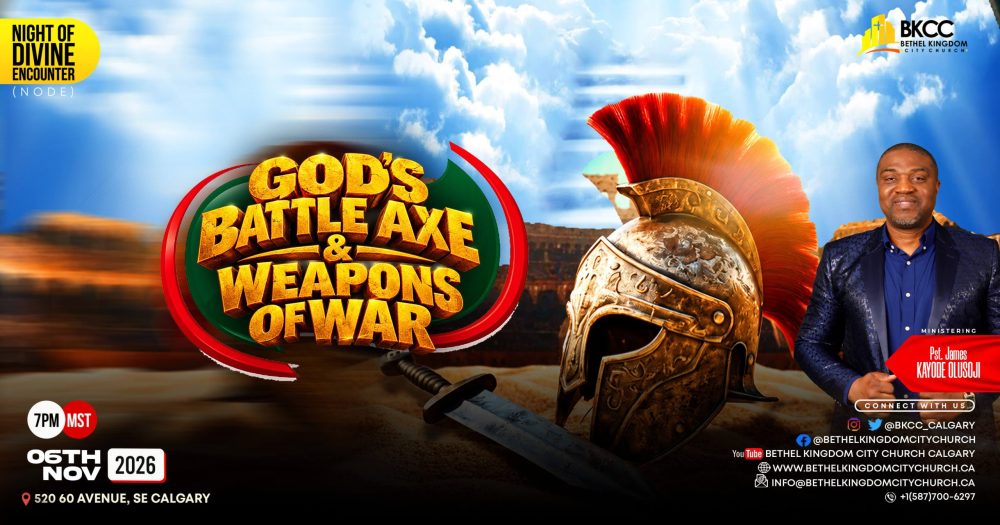
Join us for a transformative time of prayer and worship during our corporate prayer sessions:
- Early Morning Prayers: Stream live on our website daily from October 31st to November 5th, 2026, between 5:00 AM and 6:00 AM MST.
- Night of Divine Encounter: Participate online or in person on Friday, November 5th, 2026 from 7:00 PM to 10:00 PM MST. We will hold our physical meeting at:
520 60 Avenue, SE, Calgary.
You can also stream live via our Church’s website, Facebook, Twitter, or YouTube channels.
Become Part of the BKCC Family:
- Interested in becoming a member? Fill out the “I’m New“ form on our website, and we’ll reach out to you.
- Ready to serve? Complete the “Volunteer“ form, and we’ll connect with you about opportunities.
- Want to support the work of God? Visit the “Give“ section of our website to learn how you can contribute.
- Share your testimony with us by emailing [email protected].
We look forward to connecting with you as we experience God’s divine presence together!
Check Out NODE Instructions:
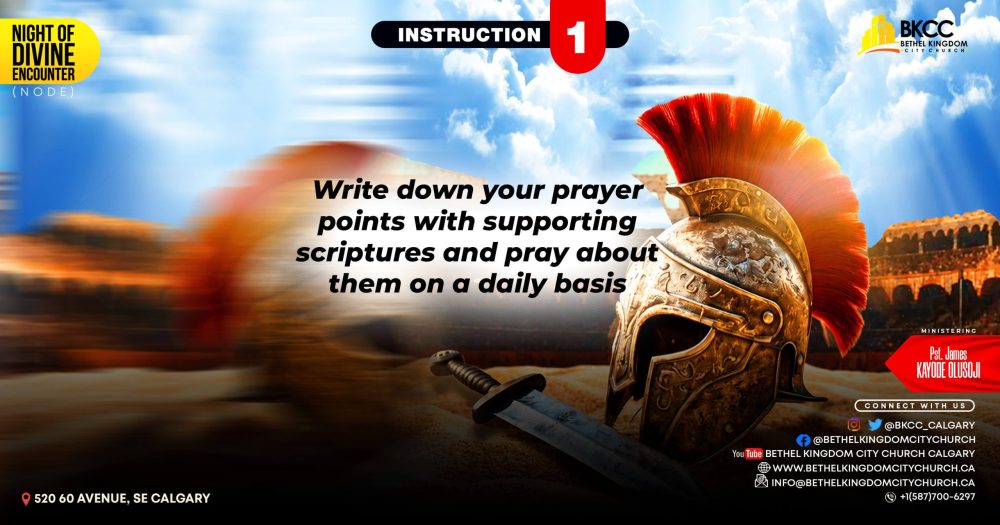

Welcome to Bethel Kingdom City Church Online – Church Without Walls
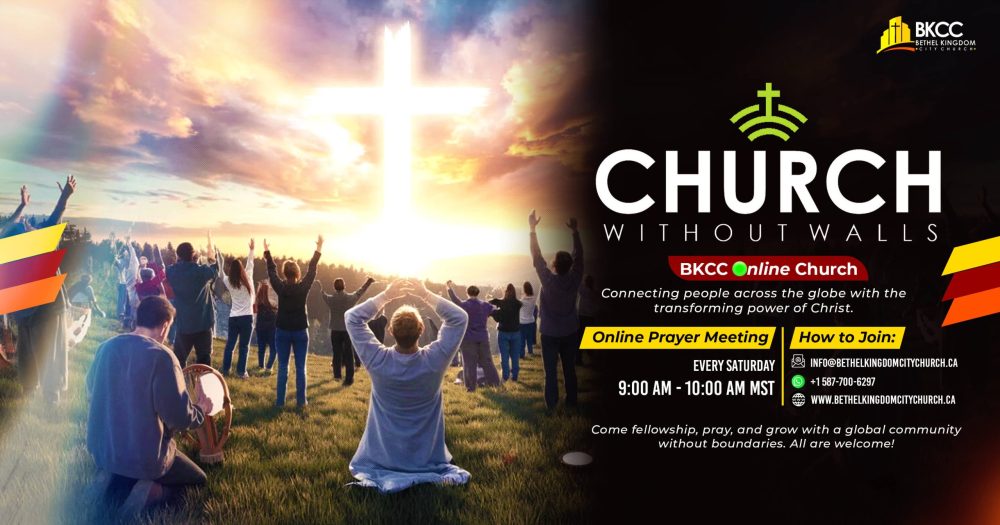
No matter where you are in the world, you are invited to be part of a growing global community centered on faith, prayer, and the transforming power of Jesus Christ. Bethel Kingdom City Church Online is a place where boundaries disappear and hearts connect.
Join us as we fellowship, pray, and grow together—online, yet united in spirit.
How to Connect With Us:
-
📧 Email: [email protected]
-
📞 Phone/WhatsApp: +1 (587) 700-6297
-
🌐 New Here? Simply fill out the “I’m New” form on our website
Whether you’re seeking prayer, community, or a deeper walk with Christ, there’s a place for you here.
All are welcome—come and experience Church Without Walls.
A Global Reach of 207 Countries in 2025 via BKCC Church’s Website

