


Prayer for Beauty for Ashes
Prayer for Beauty for Ashes: How God Turns Pain, Loss, Delay, and Disappointment into Restoration
There are seasons in life when circumstances seem to have taken everything beautiful away. A person may experience rejection, disappointment, failure, delay, loss, poverty, affliction, or years of unanswered prayer. At such moments, life can feel like a pile of ashes—the remains of something that was once beautiful.
Yet the Word of God gives us hope. God can give beauty for ashes. He can take what appears ruined and bring forth something beautiful from it. He can turn mourning into joy, failure into testimony, shame into honour, captivity into freedom, and a painful past into a platform for a glorious future.
The promise is beautifully expressed in Isaiah 61:3:
“To console those who mourn in Zion, To give them beauty for ashes, The oil of joy for mourning, The garment of praise for the spirit of heaviness…”
— Isaiah 61:3 (NKJV)
This is the heart of our Prayer for Beauty for Ashes. We are asking God to take every area of our lives that has been marked by pain, disappointment, loss, or shame and transform it according to His purpose and grace.
The Bible contains many stories of people whose situations looked hopeless, yet God changed their stories. Their lives teach us that ashes do not have to be the end of the story.
God Can Give You Beauty for Ashes
God is able to take the broken pieces of a person’s life and bring something beautiful out of them.
What looks like an ending to us may become the beginning of a new chapter in God’s plan.
What looks like failure may become preparation.
What looks like delay may become divine timing.
What looks like rejection may become repositioning.
What looks like loss may eventually become a testimony.
The story of Jabez is a powerful example.
His mother named him Jabez because she bore him in pain. His name was associated with sorrow and pain. Yet Jabez did not allow the painful meaning attached to his name to determine his destiny.
Instead, he cried out to God:
“Oh, that You would bless me indeed, and enlarge my territory, that Your hand would be with me, and that You would keep me from evil, that I may not cause pain!”
The Bible then says:
“So God granted him what he requested.”
— 1 Chronicles 4:9–10 (NKJV)
Jabez’s beginning carried pain, but his prayer led to a different outcome.
His story shows us that your beginning does not have to determine your ending.
The label placed upon your life does not have to become your permanent identity.
A painful history does not mean that your future must remain painful.
God can take the ashes of your past and give you beauty.
Jesus Christ: The Ultimate Example of Beauty for Ashes
The greatest example of God’s ability to transform apparent humiliation into glory is Jesus Christ.
Jesus left the glory of heaven and entered the world as a humble servant. He was born into humble circumstances, laid in a manger, and eventually subjected Himself to rejection, suffering, crucifixion, and death.
Philippians 2:7–8 tells us that Christ humbled Himself and became obedient to the point of death—even the death of the cross.
From the human perspective, the cross looked like defeat.
The disciples saw their Master arrested.
They saw Him beaten.
They saw Him mocked.
They saw Him crucified.
They saw Him die.
Everything appeared to have ended in ashes.
Yet the cross was not the end.
The resurrection followed the crucifixion.
God exalted Christ.
Paul continues:
“Therefore God also has highly exalted Him and given Him the name which is above every name…”
— Philippians 2:9 (NKJV)
Jesus’ story demonstrates a powerful principle:
Humiliation was followed by exaltation.
Suffering was followed by glory.
Death was followed by resurrection.
The cross was followed by a name above every name.
Jesus’ life also demonstrates the importance of total obedience to God. His exaltation followed His humble obedience to the Father’s will, even when obedience led Him to the cross.
Therefore, when we pray for beauty for ashes, we should not only ask God to change our circumstances. We should also ask Him to give us the grace to remain obedient to Him while we go through difficult seasons.
Our ashes may not disappear immediately, but our obedience can position us to experience what God has prepared for us.
Israel: From Bondage and Hard Labour to Freedom and Provision
The children of Israel also experienced a remarkable transformation.
God had made promises to their patriarchs—Abraham, Isaac, and Jacob—concerning the land He would give them, a land described as flowing with milk and honey.
Yet what happened to their descendants in Egypt appeared to be the exact opposite of what God had promised.
Instead of living in freedom, they became slaves.
Instead of enjoying their inheritance, they lived in servitude.
Instead of experiencing abundance, they endured hard labour and oppression.
Their circumstances seemed to contradict God’s promise.
For generations, they suffered under Egyptian bondage.
But God did not forget them.
When they cried out, God heard them. He raised Moses and sent him to Pharaoh. Through Moses, God confronted Pharaoh and brought Israel out of Egypt through His mighty power.
The plagues that came upon Egypt eventually led Pharaoh to release the Israelites.
Their situation changed dramatically.
The slaves became free.
The oppressed became liberated.
Those who had been stagnant began moving toward their destiny.
Those who had been dependent upon an oppressive system were now moving toward the land God had promised.
Their deliverance was more than an escape.
It was the beginning of a new chapter.
Beauty for Ashes Through Divine Provision
God also provided materially for the Israelites as they left Egypt.
Before their departure, the Israelites asked the Egyptians for articles of silver, gold, and clothing, and the Egyptians gave them what they requested. Exodus 12:35–36 records that the Israelites received possessions from the Egyptians. This was part of God’s deliverance and provision after years of oppression.
What had looked like a life of humiliation was now becoming a testimony of God’s faithfulness.
Their story demonstrates that God can restore dignity after prolonged oppression.
He can take a season of deprivation and open a door into a season of provision.
He can take people who have been pushed down and give them the opportunity to rise.
He can transform the story of a family, a generation, or a nation.
The Israelites had known the ashes of bondage.
God led them toward the beauty of freedom and promise.
Joseph: From the Pit to the Palace
Joseph’s story is another powerful example of beauty for ashes.
Joseph dreamed that one day he would occupy a position of authority and that his brothers would bow before him. His dreams were repeated, and the repetition suggested that the matter was firmly established in God’s plan.
Genesis 41:32 later explains that Pharaoh’s repeated dream indicated that the matter was established by God and would soon come to pass.
However, what happened to Joseph after he received those dreams seemed completely opposite to his future.
His brothers envied him.
They rejected him.
They threw him into a pit.
Then they sold him into slavery.
From the pit, Joseph went into slavery.
From slavery, he eventually ended up in prison because of a false accusation made against him.
His journey appeared to be going backward.
Dream → Pit → Slavery → Prison
Yet God had not abandoned him.
One day, everything changed.
Pharaoh needed someone who could interpret his dreams. Joseph was brought out of prison and stood before the most powerful ruler in Egypt.
Joseph interpreted the dreams and presented a wise plan for dealing with the coming famine.
Pharaoh then elevated him to a position of enormous authority:
“See, I have set you over all the land of Egypt.”
— Genesis 41:41 (NKJV)
Joseph went from prisoner to Prime Minister.
The land where he had suffered became the land where he was elevated.
The country where he had been mistreated became the country where he became a leader.
The one who had been rejected became a person through whom many lives were preserved.
That is beauty for ashes.
Joseph’s story teaches us that what looks like a detour may still be part of God’s route to your destiny.
God Can Turn the Ashes of Barrenness into Beauty
The Bible also contains several stories of women who experienced prolonged barrenness and eventually received children.
These stories remind us that a long wait does not mean that God has forgotten His promise.
Sarah
Sarah waited for many years before giving birth to Isaac.
She gave birth when she was 90 years old, while Abraham was 100 (Genesis 17:17; 21:1–5).
From a human perspective, the promise appeared impossible.
Yet God fulfilled His word.
Isaac became evidence that God’s promise had not died.
The years of waiting became part of the testimony.
Barrenness gave way to fruitfulness.
Rebekah
Rebekah also experienced a lengthy period without children.
Isaac was forty years old when he married Rebekah, and Genesis 25 records that Isaac prayed to the Lord for his wife because she was barren. Rebekah eventually conceived and gave birth to twins, Esau and Jacob (Genesis 25:20–26).
Her long wait ended in fruitfulness.
Out of what looked like emptiness came two nations.
God transformed her season of waiting into a remarkable testimony.
Rachel
Rachel also experienced a long struggle with barrenness.
Eventually, God remembered Rachel and opened her womb, and she gave birth to Joseph (Genesis 30:22–24).
Later, she gave birth to Benjamin (Genesis 35:16–18).
Rachel’s story demonstrates that a prolonged delay can eventually become a testimony of answered prayer.
What had caused pain became a source of joy.
Hannah
Hannah’s story is another beautiful example.
She experienced deep sorrow because she was unable to have children, while Peninnah repeatedly provoked and humiliated her.
Hannah eventually cried out to God and prayed deeply for a child.
God answered her prayer, and she gave birth to Samuel.
Later, Scripture records that Hannah had additional children:
“And the LORD visited Hannah, so that she conceived and bore three sons and two daughters.”
— 1 Samuel 2:21 (NKJV)
The woman who had experienced years of sorrow became a mother of several children.
Her tears became a testimony.
Her pain became praise.
Her barrenness gave way to fruitfulness.
That is beauty for ashes.
Elizabeth
Elizabeth and Zechariah also experienced the pain of childlessness into their old age.
Luke 1 describes Elizabeth as barren and says that both she and Zechariah were advanced in years.
Yet God answered their prayer.
Elizabeth conceived and gave birth to John the Baptist, the forerunner of Jesus Christ (Luke 1:5–25, 57–66).
What appeared to be a permanently closed chapter became an extraordinary testimony.
God brought beauty out of their years of waiting.
Your Waiting Season Does Not Mean God Has Forgotten You
The stories of Sarah, Rebekah, Rachel, Hannah, and Elizabeth remind us that God is able to intervene in seasons that seem impossible.
A prolonged wait can be emotionally exhausting.
Repeated disappointment can weaken faith.
Watching others receive what you have been praying for can create questions in the heart.
Yet Scripture encourages us to trust God’s timing.
God’s ability is not limited by human age.
God’s promise is not cancelled by delay.
God’s purpose is not destroyed by waiting.
A season of barrenness can become a testimony of fruitfulness.
Therefore, our prayer should be:
“Lord, give me beauty for ashes.”
Examples of Those Who Turned Beauty into Ashes
While the Bible shows us people whose ashes God transformed into beauty, it also gives us warnings about people who had beauty, honour, authority, and opportunity but lost them because of pride and disobedience.
These examples teach us an important lesson:
We should not only pray for God to give us beauty for ashes; we must also pray for the wisdom and humility to preserve the beauty God gives us.
Satan: From Beauty to Judgment
The Bible uses prophetic language in Ezekiel 28 concerning the king of Tyre, describing extraordinary beauty, privilege, and pride. This passage figuratively reflects Satan’s rebellion, although the immediate context addresses the king of Tyre.
The passage describes Satan as one who was adorned with beauty and privilege but became proud.
The great lesson is that pride can turn honour into disgrace.
The New Testament clearly teaches that Satan faces ultimate judgment. Revelation 20:10 speaks of the devil being cast into the lake of fire and brimstone.
Therefore, the biblical principle is sobering:
Beauty without humility can become ashes.
God can bless a person with influence, beauty, wealth, authority, or spiritual opportunities, but pride can destroy what God has entrusted to that person.
Saul: From Kingship to Rejection
Saul was the first king of Israel.
God gave him an extraordinary opportunity.
He was chosen to lead God’s people and was initially given a position of honour.
Yet Saul’s disobedience eventually affected his kingship.
In 1 Samuel 15, Saul failed to obey God’s specific command concerning the Amalekites.
Samuel told him:
“Because you have rejected the word of the LORD, He also has rejected you from being king.”
— 1 Samuel 15:23 (NKJV)
Saul had beauty in the form of kingship, authority, and opportunity.
But his disobedience turned that beauty into ashes.
This teaches us that obedience is essential to preserving what God gives us.
We should never assume that yesterday’s blessing gives us permission to disobey God today.
A beautiful position can become a painful loss when pride and disobedience take control.
Adam and Eve: From the Beauty of Eden to the Consequences of Sin
Adam and Eve were placed in a beautiful environment.
They lived in the Garden of Eden.
They enjoyed fellowship with God.
They had access to the trees of the garden.
They had an extraordinary level of provision.
Yet they were given one clear restriction:
They were not to eat from the tree of the knowledge of good and evil (Genesis 2:16–17).
The tragedy is that they were surrounded by God’s abundance, yet they became focused on the one thing God had forbidden.
Human beings can sometimes overlook countless blessings because they focus on the single thing they have been told not to have. Adam and Eve had abundant provision, but dissatisfaction with the forbidden brought devastating consequences.
Their disobedience brought sin, shame, separation, and death into the human experience.
The beauty of Eden gave way to the ashes of a fallen world.
This teaches us to appreciate God’s blessings and obey His instructions.
Do not allow what you cannot have to make you despise what God has already given you.
Herod: When Pride Turns Glory into Ashes
Herod provides another solemn warning.
Acts 12 records an occasion when Herod delivered a speech and the people shouted:
“The voice of a god and not of a man!”
— Acts 12:22 (NKJV)
Herod did not give glory to God.
The Bible says:
“Then immediately an angel of the Lord struck him, because he did not give glory to God. And he was eaten by worms and died.”
— Acts 12:23 (NKJV)
Herod’s story demonstrates the danger of taking glory that belongs to God.
Power can become dangerous when it produces pride.
Success can become destructive when a person forgets the One who gave the opportunity.
Influence can become a trap when someone begins to believe that the applause of people belongs to him rather than God.
Therefore, if we are asking God for beauty for ashes, we must also ask Him to keep us humble when the beauty arrives.
Never take God’s glory for yourself.
Nebuchadnezzar: From Royal Glory to Humiliation and Back Again
King Nebuchadnezzar was another powerful ruler who experienced the danger of pride.
God had allowed him to become a great ruler over nations.
He possessed tremendous wealth, authority, influence, and power.
Yet pride entered his heart.
Daniel 4 records the warning he received through a dream and Daniel’s interpretation. Eventually, Nebuchadnezzar experienced a dramatic humbling.
He was driven from human society and lived as though he were an animal.
His royal glory was temporarily stripped away.
The man who had ruled nations now experienced deep humiliation.
Yet his story contains another powerful lesson because God eventually restored him.
After Nebuchadnezzar lifted his eyes to heaven and acknowledged God’s sovereignty, his understanding returned and his kingdom was restored (Daniel 4:34–37).
Here we see both sides of the principle:
Beauty can become ashes through pride.
But God can also restore beauty after repentance and humility.
This is one of the most encouraging parts of the story.
Nebuchadnezzar lost much because of pride, but his restoration shows that God is able to restore what has been broken when a person humbles himself before Him.
What Can We Learn From These Stories?
The stories in Scripture give us both encouragement and warning.
Jabez teaches us that a painful beginning does not have to determine the outcome of our lives.
Israel teaches us that prolonged oppression can give way to freedom.
Joseph teaches us that the pit and the prison are not necessarily the end of destiny.
Sarah, Rebekah, Rachel, Hannah, and Elizabeth teach us that seasons of waiting and barrenness can eventually give way to fruitfulness.
Jesus Christ demonstrates the greatest example of suffering followed by exaltation and reminds us of the power of total obedience to God.
Saul warns us about the consequences of disobedience.
Adam and Eve warn us against dissatisfaction and disobedience in the midst of God’s abundance.
Herod teaches us not to take God’s glory for ourselves.
Nebuchadnezzar teaches us the danger of pride and the possibility of restoration through humility.
These stories bring us back to the central message:
God Can Give You Beauty for Ashes
Perhaps there are ashes in your life today.
Maybe you have lost something important.
Maybe you have endured years of disappointment.
Maybe you are waiting for a breakthrough.
Maybe your career seems stuck.
Maybe your finances have suffered.
Maybe you have experienced rejection.
Maybe your family has gone through a difficult period.
Maybe you have prayed about the same issue for years.
Maybe something you once considered beautiful now looks completely broken.
Do not conclude that the ashes are the final chapter.
The God who worked in the lives of Jabez, Israel, Joseph, Hannah, Sarah, Rebekah, Rachel, Elizabeth, and many others is still able to bring restoration.
Isaiah 61:3 gives us the beautiful picture of God exchanging:
Beauty for ashes.
Joy for mourning.
Praise for heaviness.
God is able to transform the consequences of painful seasons and use them as part of a greater testimony.
Prayer for Beauty for Ashes
Heavenly Father,
I come before You today with faith and confidence in Your power.
You are the God who can give beauty for ashes, the oil of joy for mourning, and the garment of praise for the spirit of heaviness.
Lord, look upon every area of my life that has been covered with ashes.
Where there has been pain, bring healing.
Where there has been loss, bring restoration.
Where there has been rejection, bring acceptance according to Your perfect will.
Where there has been shame, bring honour.
Where there has been failure, give me another opportunity.
Where there has been stagnation, release progress.
Where there has been poverty and lack, provide according to Your purpose.
Where there has been barrenness, bring fruitfulness.
Where there has been prolonged waiting, let Your appointed time come.
Where there has been captivity, bring freedom.
Where there has been disappointment, give me a testimony.
Father, just as You changed the story of Jabez, change every negative label attached to my life.
Just as You delivered Israel from Egypt, deliver me from every form of bondage that has hindered my progress.
Just as You brought Joseph from the pit and prison into the palace, bring me into the place You have prepared for me.
Just as You remembered Sarah, Rebekah, Rachel, Hannah, and Elizabeth, remember me in every area where I am waiting for You.
Lord Jesus, thank You for giving Yourself completely to the Father’s will. Teach me to walk in obedience, even when obedience is difficult.
Give me grace to trust You when I cannot understand what You are doing.
Help me not to become bitter during my waiting season.
Help me not to lose faith because the answer has taken longer than expected.
Help me not to compare my journey with the journey of others.
Give me patience to wait.
Give me faith to believe.
Give me wisdom to prepare.
Give me courage to act when You open the door.
And when You finally turn my ashes into beauty, help me remain humble.
Keep me from pride.
Keep me from taking Your glory.
Keep me from becoming like Saul, who lost his position through disobedience.
Keep me from the dissatisfaction that affected Adam and Eve.
Keep me from the pride that brought down Herod.
Keep me from the arrogance that humbled Nebuchadnezzar.
Let every blessing You give me draw me closer to You.
May my testimony never become an idol.
May my success never replace my relationship with You.
May my prosperity never make me forget You.
May my promotion never make me proud.
May everything You place in my hands bring glory to Your name.
Father, give me beauty for every ash.
Give me joy for every season of mourning.
Give me praise for every spirit of heaviness.
Give me restoration for every place of loss.
Give me fruitfulness for every place of barrenness.
Give me testimony for every season of trial.
Let the ashes of yesterday become the testimony of tomorrow.
Turn my pain into purpose.
Turn my tears into testimony.
Turn my disappointment into divine appointment.
Turn my rejection into repositioning.
Turn my waiting into manifestation according to Your perfect timing.
Above all, let my life become a testimony of Your faithfulness.
In the mighty name of Jesus Christ, Amen.
Final Encouragement
Never forget that ashes are not always the end.
Jabez had a painful name, but God answered his prayer.
Israel endured years of bondage, but God brought them into freedom.
Joseph experienced betrayal, slavery, and prison, but God elevated him.
Sarah waited for a child, but God fulfilled His promise.
Rebekah waited, but God gave her children.
Rachel waited, but God remembered her.
Hannah wept, but God turned her tears into joy.
Elizabeth waited into old age, but God gave her John the Baptist.
Jesus endured the cross, but God highly exalted Him.
These stories remind us that God can write a beautiful ending to a painful chapter.
Your ashes may represent something you have lost, but they do not have to define your future.
Your past may have been painful, but your future can still be glorious.
Your tears may be real, but joy can still come.
Your waiting may be long, but God can still remember you.
Your situation may look impossible, but nothing is impossible with God.
Therefore, keep praying.
Keep believing.
Keep obeying.
Keep trusting.
Keep walking with God.
The God who gives beauty for ashes is able to transform your story and make your life a testimony that will bring glory to His name.
“To give them beauty for ashes, The oil of joy for mourning, The garment of praise for the spirit of heaviness…”
— Isaiah 61:3 (NKJV)
May God give you beauty for ashes, joy for mourning, praise for heaviness, restoration for loss, and a testimony in place of every season of pain. In Jesus’ name, Amen.
Prayer Points: Prayer for Beauty for Ashes
- Lord, let the anointing of Your Spirit rest upon me to heal every broken heart, break every bondage, and replace my ashes with Your divine beauty. Strip away the spirit of heaviness and cloth me with the garment of praise that You may be glorified.
Isaiah 61:1–3 (NKJV)
“The Spirit of the Lord GOD is upon Me, because the LORD has anointed Me to preach good tidings to the poor; He has sent Me to heal the brokenhearted, to proclaim liberty to the captives, and the opening of the prison to those who are bound; to proclaim the acceptable year of the LORD, and the day of vengeance of our God; to comfort all who mourn, to console those who mourn in Zion, to give them beauty for ashes, the oil of joy for mourning, the garment of praise for the spirit of heaviness; that they may be called trees of righteousness, the planting of the LORD, that He may be glorified.”
- Father, turn my mourning into dancing. Remove my sackcloth of sorrow, clothe me with Your gladness, and let my life continually sing praises to Your name.
Psalm 30:11–12 (NKJV)
“You have turned for me my mourning into dancing; You have put off my sackcloth and clothed me with gladness, to the end that my glory may sing praise to You and not be silent. O LORD my God, I will give thanks to You forever.”
- Lord, step into my season of grief and turn my mourning into exuberant joy. Comfort my soul and let absolute rejoicing replace every sorrow.
Jeremiah 31:13 (NKJV)
“Then shall the virgin rejoice in the dance, and the young men and the old together; for I will turn their mourning to joy, will comfort them, and make them rejoice rather than sorrow.”
- Almighty God, I ask for total restoration of all the years the locusts have eaten in my life. Cause me to eat in plenty, be deeply satisfied, and let me never be put to shame.
Joel 2:25–26 (NKJV)
“So I will restore to you the years that the swarming locust has eaten, the crawling locust, the consuming locust, and the chewing locust, My great army which I sent among you. You shall eat in plenty and be satisfied, and praise the name of the LORD your God, who has dealt wondrously with you; and My people shall never be put to shame.”
- Lord, even as I walk and sow through a season of tears, let my harvest be wrapped in overwhelming joy. Bring me back with rejoicing, carrying the heavy sheaves of Your blessings.
Psalm 126:5–6 (NKJV)
“Those who sow in tears shall reap in joy. He who continually goes forth weeping, bearing seed for sowing, shall doubtless come again with rejoicing, bringing his sheaves with him.”
- Father, I trust that You are actively working every painful and broken circumstance in my life together for my good, aligned with Your ultimate purpose.
Romans 8:28 (NKJV)
“And we know that all things work together for good to those who love God, to those who are the called according to His purpose.”
- Lord, visit me with miraculous restoration just as You did for Job. Bless my latter days far greater than my beginning, and double my portion for all my trouble.
Job 42:10-12 (NKJV)
“And the Lord restored Job’s losses when he prayed for his friends. Indeed the Lord gave Job twice as much as he had before. 11 Then all his brothers, all his sisters, and all those who had been his acquaintances before, came to him and ate food with him in his house; and they consoled him and comforted him for all the adversity that the Lord had brought upon him. Each one gave him a piece of silver and each a ring of gold. 12 Now the Lord blessed the latter days of Job more than his beginning; for he had fourteen thousand sheep, six thousand camels, one thousand yoke of oxen, and one thousand female donkeys.”
- Jehovah, wipe away every tear from my eyes. Let death, sorrow, crying, and pain pass away permanently from my experience as You make all things new.
Revelation 21:4 (NKJV)
“And God will wipe away every tear from their eyes; there shall be no more death, nor sorrow, nor crying. There shall be no more pain, for the former things have passed away.”
- Lord, give me the grace to view my current trials as momentary light afflictions, knowing they are producing in me an eternal weight of glory.
2 Corinthians 4:17 (NKJV)
“For our light affliction, which is but for a moment, is working for us a far more exceeding and eternal weight of glory.”
- Father, rebuild every ruined and desolate area of my life until it resembles the garden of Eden. Let those around me recognize that You are the Lord who restores what was broken.
Ezekiel 36:35–36 (NKJV)
“So they will say, ‘This land that was desolate has become like the garden of Eden; and the wasted, desolate, and ruined cities are now fortified and inhabited.’ Then the nations which are left all around you shall know that I, the LORD, have rebuilt the ruined places and planted what was desolate. I, the LORD, have spoken it, and I will do it.”
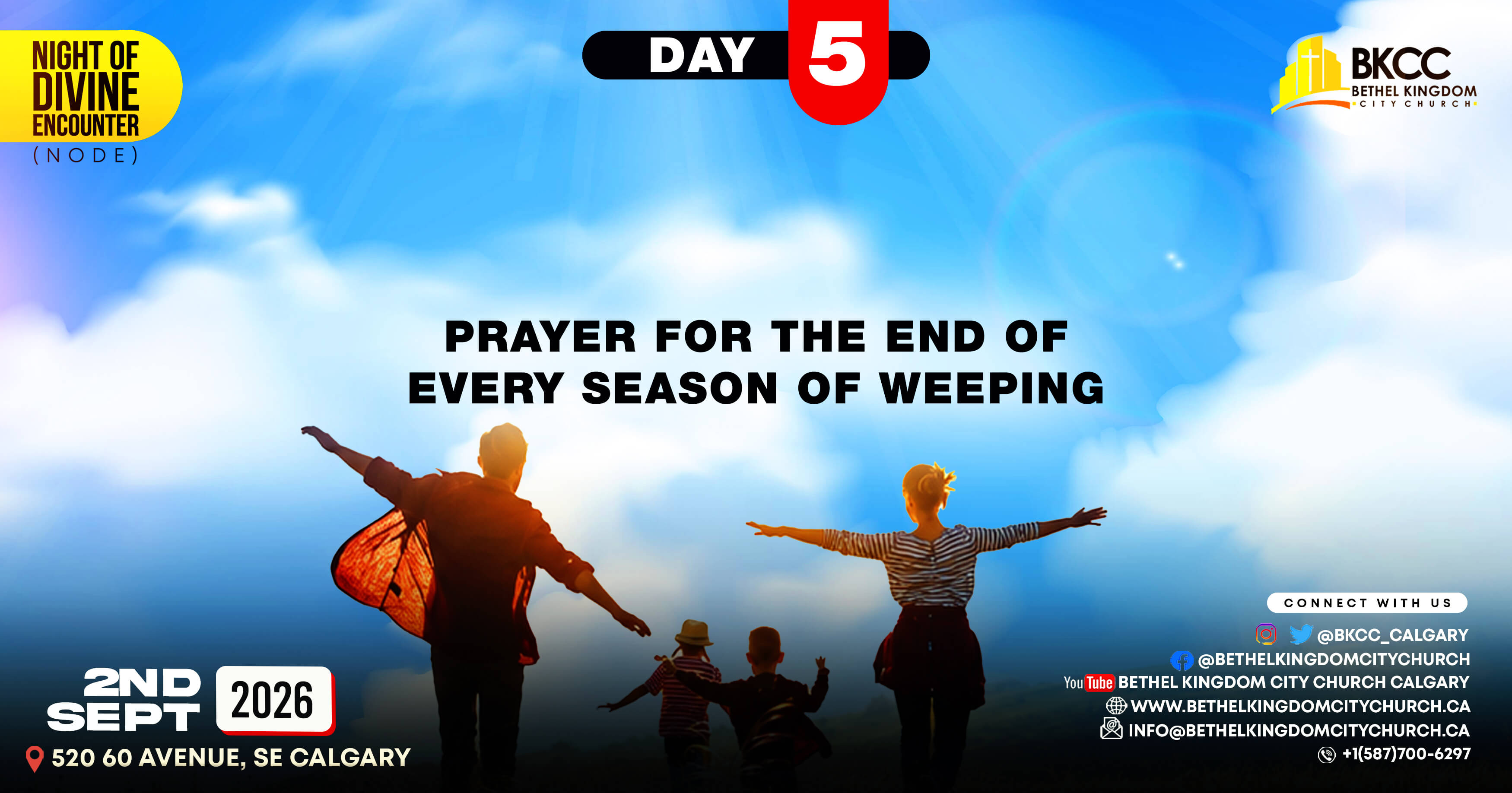
- Lord, I submit every changing season of my life into Your hands. Bring me out of the season of weeping and mourning, and usher me fully into the season of laughing and dancing.
Ecclesiastes 3:1 (NKJV)
“To everything there is a season, a time for every purpose under heaven”
Ecclesiastes 3:4 (NKJV)
“A time to weep, and a time to laugh; a time to mourn, and a time to dance.”
- Father, as one of Your ransomed, I return to You with singing and everlasting joy crowned upon my head. Let all sorrow and sighing flee away from my path forever.
Isaiah 35:10 (NKJV)
“And the ransomed of the LORD shall return, and come to Zion with singing, with everlasting joy on their heads. They shall obtain joy and gladness, and sorrow and sighing shall flee away.”
- Lord Jesus, stretch forth Your hand right now to heal my broken heart and expertly bind up all my bleeding wounds.
Psalm 147:3 (NKJV)
“He heals the brokenhearted and binds up their wounds.”
- O Lord, deal with every adversary and force that afflicts my life. Gather me from where I was scattered, turn my past shame into praise and fame, and let me witness Your deliverance firsthand.
Zephaniah 3:19–20 (NKJV)
“Behold, at that time I will deal with all who afflict you; I will save the lame, and gather those who were driven out; I will appoint them for praise and fame in every land where they were put to shame. At that time I will bring you back, even at the time I gather you; for I will give you fame and praise among all the peoples of the earth, when I return your captives before your eyes,” says the LORD.
- Father, though weeping may endure for a night, let my sorrow be swiftly transformed into unstoppable joy. Fill my heart with a rejoicing spirit that no person or circumstance can ever take away from me.
John 16:20 (NKJV)
“Most assuredly, I say to you that you will weep and lament, but the world will rejoice; and you will be sorrowful, but your sorrow will be turned into joy.
John 16:22 (NKJV)
Therefore you now have sorrow; but I will see you again and your heart will rejoice, and your joy no one will take from you.”
Be a Part of the Night of Divine Encounter:

Join us for a transformative time of prayer and worship during our corporate prayer sessions:
- Early Morning Prayers: Stream live on our website daily from August 27th to September 4th, 2026, between 5:00 AM and 6:00 AM MST.
- Night of Divine Encounter: Participate online or in person on Friday, September 4th, 2026 from 7:00 PM to 10:00 PM MST. We will hold our physical meeting at:
520 60 Avenue, SE, Calgary.
You can also stream live via our Church’s website, Facebook, Twitter, or YouTube channels.
Become Part of the BKCC Family:
- Interested in becoming a member? Fill out the “I’m New“ form on our website, and we’ll reach out to you.
- Ready to serve? Complete the “Volunteer“ form, and we’ll connect with you about opportunities.
- Want to support the work of God? Visit the “Give“ section of our website to learn how you can contribute.
- Share your testimony with us by emailing [email protected].
We look forward to connecting with you as we experience God’s divine presence together!
Check Out NODE Instructions:
Welcome to Bethel Kingdom City Church Online – Church Without Walls

No matter where you are in the world, you are invited to be part of a growing global community centered on faith, prayer, and the transforming power of Jesus Christ. Bethel Kingdom City Church Online is a place where boundaries disappear and hearts connect.
Join us as we fellowship, pray, and grow together—online, yet united in spirit.
How to Connect With Us:
-
📧 Email: [email protected]
-
📞 Phone/WhatsApp: +1 (587) 700-6297
-
🌐 New Here? Simply fill out the “I’m New” form on our website
Whether you’re seeking prayer, community, or a deeper walk with Christ, there’s a place for you here.
All are welcome—come and experience Church Without Walls.
A Global Reach of 207 Countries in 2025 via BKCC Church’s Website

