


Divine Deployment: Fulfilling Your Divine Assignment
Divine Deployment: How God Empowers You to Fulfil Your Divine Assignment
God does not prepare His people without purpose. He calls, teaches, equips, and empowers believers so they can participate faithfully in His work on earth. Fulfilling your divine assignment means responding obediently to God’s direction and using the gifts, opportunities, and spiritual empowerment He provides to serve others and advance the gospel.
A soldier may receive training, equipment, and instructions, but those preparations must eventually be put into practice. In a similar way, Christian growth is not intended to end with personal knowledge or spiritual experiences alone. God calls His people to live out their faith through service, witness, love, and obedience.
Jesus trained His disciples and then commissioned them to make disciples of all nations. Before they went, however, He instructed them to wait for the promised power of the Holy Spirit. Their mission required both a commission and divine empowerment.
This leads to an important question: How can believers become ready for divine deployment and faithfully fulfil the assignments God entrusts to them?
What Is Divine Deployment?
Divine deployment is the process by which God directs and empowers believers to serve according to His purposes. It involves responding to His Word, developing spiritual maturity, using God-given abilities, and carrying out the responsibilities associated with Christian discipleship.
The expression divine deployment is a teaching metaphor rather than a formal biblical term. It draws on biblical themes of calling, sending, equipping, commissioning, and witnessing.
Divine deployment may involve preaching the gospel, discipling new believers, serving in a local church, supporting people in need, using professional skills ethically, raising children in the faith, or contributing to a community’s well-being. Not every assignment takes place on a platform or attracts public attention.
The central issue is not how visible an assignment is but whether it is faithful to God’s revealed purposes.
God Prepares His People Before Sending Them
Preparation is an important part of Christian service. Before the disciples were commissioned to carry the gospel to the nations, they spent time learning from Jesus, observing His ministry, and receiving His instructions.
Jesus did not simply give His followers a task and leave them without guidance. He taught them about the kingdom of God and prepared them for the responsibilities they would carry.
Second Timothy 3:16–17 explains that Scripture equips God’s people for every good work. Similarly, Ephesians 4:11–13 describes the equipping of the saints for the work of ministry and the building up of Christ’s body.
These passages show that spiritual preparation involves more than acquiring information. It includes growing in character, learning sound doctrine, developing practical skills, and becoming increasingly mature in faith.
What does God use to prepare believers?
His Word: Scripture teaches believers what is true, corrects error, and guides conduct.
Prayer and fellowship with God: Prayer helps believers seek wisdom, examine their motives, and remain dependent on God.
Discipleship and mentorship: Mature Christian leaders can teach, encourage, and help believers develop their gifts responsibly.
Service and experience: Faithfulness in ordinary responsibilities can prepare a person for greater or different responsibilities.
Correction and spiritual growth: God can use instruction, conviction, and difficult seasons to expose weaknesses and cultivate humility.
Preparation should not become an excuse for endless delay. Believers should grow while also serving faithfully in the opportunities already available to them.
God Does Not Light a Lamp for It to Remain Hidden
In Matthew 5:14–16, Jesus describes His followers as the light of the world. He teaches that a lamp is placed where it can give light and that believers should let their light shine through good works that glorify the Father.
The illustration is straightforward: light is meant to illuminate its surroundings. In the same way, Christian faith should become visible through conduct that reflects God’s character.
A believer’s light may shine through compassionate service, honest business practices, encouragement, evangelism, responsible leadership, generosity, or the faithful use of professional abilities.
The passage does not teach that every believer must become famous or publicly prominent. Rather, it calls disciples to live in a way that points people toward God.
How can you let your light shine?
- Share the gospel respectfully and faithfully.
- Use your gifts to serve people rather than seeking attention.
- Demonstrate integrity in your workplace and relationships.
- Support those who are vulnerable or in need.
- Encourage other believers to grow in faith.
- Be consistent between your public profession and private conduct.
A believer who has received opportunities to serve should consider how to use them faithfully. Spiritual gifts and practical abilities become useful to others when they are put into action.
Read Matthew 5:14–16 in the NKJV.
Divine Deployment Requires Obedience to God’s Direction
A person may be willing to serve God yet struggle when the assignment differs from personal preference. The task may be unfamiliar, inconvenient, uncomfortable, or located somewhere the person would not have chosen.
Jesus provides the supreme example of obedience. In Luke 22:42, while praying in Gethsemane before His crucifixion, He submitted to the Father’s will: “nevertheless not My will, but Yours, be done.”
Jesus’ prayer reveals the seriousness of His coming suffering and His submission to the Father’s purpose. Christian obedience follows this pattern of placing God’s will above personal preference.
Obedience does not mean abandoning wisdom, ethical responsibility, or careful discernment. Believers should examine potential assignments in light of Scripture, seek wise counsel, consider their responsibilities, and pray for understanding.
Jonah: A lesson in resisting an assignment
The book of Jonah 1–3 records God’s instruction to Jonah to go to Nineveh and proclaim His message. Jonah instead set out for Tarshish. A severe storm arose during his voyage, and the sailors eventually cast him into the sea. God appointed a great fish to swallow Jonah, and after Jonah’s deliverance, God renewed His command. Jonah then went to Nineveh.
Jonah’s story demonstrates the consequences of resisting a specific instruction God had given him. His eventual obedience also shows that failure does not have to be the end of a person’s response to God.
However, this narrative should be applied carefully. Not every storm, setback, illness, or hardship proves that a person has disobeyed God. The storm in Jonah’s account belongs to a particular biblical narrative in which the text explicitly connects Jonah’s flight with God’s response. We should not automatically apply that explanation to every difficult circumstance.
When facing a challenge, a believer can prayerfully ask:
- Have I neglected something Scripture clearly commands?
- Am I resisting a responsibility because it is uncomfortable?
- Have I confused my personal preference with God’s direction?
- Do I need counsel, correction, or a change in approach?
- What faithful step can I take with the understanding I have?
The goal is not to interpret every hardship as punishment. It is to remain teachable and responsive to God’s Word.
Read Jonah 1–3 in the NKJV.
Jesus Is the Commander, and His Mission Is Clear
Christians are called to follow Jesus, who sends His disciples to participate in His mission.
In Matthew 28:18–20, Jesus declares His authority and commands His followers to make disciples of all nations, baptizing them and teaching them to observe His commands. He also promises to be with them always, even to the end of the age.
This is commonly called the Great Commission. It establishes a central purpose of Christian deployment: making disciples who learn and follow Jesus.
The mission is broader than speaking to people about Christianity. It includes helping people become disciples, teaching Christ’s commands, supporting spiritual growth, and participating in the life and witness of the church.
The Great Commission also places Christian service under Christ’s authority. A claimed assignment should therefore be tested against the character and teachings of Jesus. No personal impression or leadership instruction should be used to justify conduct that contradicts Scripture, abuses others, or excuses wrongdoing.
What does obedience to Jesus look like in practice?
- Know His instructions. Study Scripture so that your understanding of the mission is grounded in the Word.
- Begin where you are. Serve faithfully among the people and in the responsibilities already entrusted to you.
- Make disciples. Help others learn the teachings and practices of Jesus.
- Work with other believers. Christian mission is not merely an individual achievement; it includes the shared work of the church.
- Persevere faithfully. Continue serving even when results are gradual or recognition is limited.
Divine deployment is not about pursuing an impressive personal platform. It is about participating faithfully in the mission of Christ.
Read Matthew 28:18–20 in the NKJV.
The Holy Spirit Empowers Believers for Their Assignment
Jesus did not instruct His disciples to carry out the mission through human strength alone. Before His ascension, He told them to wait for the promise of the Father.
Acts 1:8 records Jesus’ words that His followers would receive power when the Holy Spirit came upon them and would become His witnesses in Jerusalem, Judea, Samaria, and to the end of the earth.
The passage connects spiritual empowerment with witness. The Spirit’s power was not given merely for personal status; it enabled the disciples to bear testimony to Jesus.
Acts 2 then describes the coming of the Holy Spirit at Pentecost, followed by Peter’s public proclamation of the gospel. As Acts continues, the message spreads across geographical, cultural, and social boundaries.
The disciples’ experiences show that divine empowerment and divine mission belong together. God equips His people to serve, but they remain responsible for bearing faithful witness and living in obedience.
How can believers seek the Holy Spirit’s empowerment?
- Pray for boldness, wisdom, and faithfulness.
- Study and obey the Word of God.
- Cultivate the fruit of the Spirit in everyday life.
- Use spiritual gifts in ways that build up others.
- Remain accountable to sound biblical teaching and responsible Christian community.
- Take practical steps to serve, witness, and meet genuine needs.
Spiritual empowerment should not be measured only by dramatic experiences or public miracles. Faithful witness, godly character, sacrificial service, and perseverance are also important expressions of Christian maturity.
Read Acts 1:8 in the NKJV.
God Can Deploy Believers in Different Places and Roles
Jesus told His disciples that their witness would extend from Jerusalem to Judea, Samaria, and the ends of the earth. These geographical references show the expanding scope of their mission.
The same principle reminds Christians that service can take place in different settings. Some believers may serve in their local communities; others may be called to cross-cultural missions, education, pastoral ministry, business, healthcare, community leadership, or other forms of service consistent with Christian faith.
The Bible contains many examples of people serving God in different circumstances:
- Philip proclaimed Christ in Samaria and later explained Scripture to an Ethiopian official (Acts 8:4–40).
- Paul and Barnabas were sent out for missionary work by the church at Antioch (Acts 13:1–4).
- Priscilla and Aquila helped explain the way of God more accurately to Apollos (Acts 18:24–28).
- Dorcas (Tabitha) was known for good works and charitable acts that benefited people in her community (Acts 9:36–42).
These examples demonstrate that Christian service can include preaching, teaching, mentoring, practical compassion, and participation in a community of faith.
The important question is not whether your assignment resembles someone else’s. It is whether you are faithfully using what God has entrusted to you.
Do Not Confuse Divine Deployment With Personal Promotion
The original illustration compares deployment in an army with a soldier’s opportunity to advance. It is useful as a picture of preparation leading to action, but it needs an important biblical qualification.
Scripture encourages diligence, faithfulness, and the responsible use of gifts. However, it does not guarantee that every believer who fulfils an assignment will receive immediate promotion, financial prosperity, public recognition, or freedom from hardship.
Jesus taught His disciples about humility and service. In Mark 10:43–45, He contrasted worldly ideas of greatness with the call to serve, pointing to His own example of giving His life for others.
Likewise, Paul instructed believers to work heartily as for the Lord in Colossians 3:23–24. Christian service is ultimately offered to God, not merely performed to secure recognition from people.
God may entrust greater responsibility to some people, but advancement is not the only measure of faithful service. Some assignments are hidden, costly, or long-term. Others may produce fruit that the servant does not immediately see.
A healthier perspective is this: seek faithfulness before recognition, obedience before applause, and service before status.
Whenever God opens a door, step into it with excellence. When He offers correction, lean in and learn. In seasons of waiting when results are slow, remain anchored in your faithfulness. Above all, rejoice in the success of others rather than comparing your unique calling to theirs.
How to Prepare Yourself for Divine Deployment
The desire to fulfil a divine assignment should lead to practical action. The following steps can help you respond faithfully.
Step 1: Establish a foundation in Scripture
Read the Bible consistently and seek to understand its message in context. Scripture provides the foundation for evaluating beliefs, decisions, and claimed spiritual direction.
Step 2: Develop a life of prayer
Prayer is not merely a way to request assignments. It is also a practice of worship, dependence, confession, thanksgiving, and seeking wisdom.
Step 3: Identify your gifts and responsibilities
Consider the abilities, experience, resources, opportunities, and relationships available to you. Seek honest feedback from mature believers and people who have observed your service.
Step 4: Start serving where you are
Do not wait for a dramatic announcement before doing good. Support your local church, care for your family, encourage someone who is struggling, serve your community, or use your professional abilities responsibly.
Step 5: Seek wise counsel
Talk with trustworthy, spiritually mature people who can help you evaluate your motives and plans. Counsel is especially important when a decision affects your family, finances, safety, or existing responsibilities.
Step 6: Test the assignment
Ask whether the proposed action aligns with Scripture, reflects the character of Christ, respects other people, and can be pursued responsibly. Do not treat every dream, feeling, coincidence, or instruction from a leader as unquestionable divine direction.
Step 7: Take the next faithful step
You may not understand every detail of the future. Begin with the responsibilities and opportunities you can reasonably identify, and remain willing to learn and adjust.
Step 8: Evaluate your service by its fruit
Reflect on whether your service is demonstrating love, integrity, spiritual growth, and genuine benefit to others. Seek feedback, learn from mistakes, and remain accountable.
These steps do not reduce God’s guidance to a formula. They provide a responsible framework for pursuing Christian service with humility, wisdom, and perseverance.
What Should You Do When You Feel Unready for Your Assignment?
Feeling unready does not necessarily mean you should refuse to serve. Many biblical servants experienced fear, uncertainty, opposition, or a sense of inadequacy.
However, feeling unready should not automatically be interpreted as proof that God is calling you to a particular role either. It may be a prompt to learn, seek counsel, gain experience, or reconsider whether the opportunity is appropriate.
When you feel unprepared:
- Pray for wisdom and courage.
- Identify the specific skills or knowledge you still need.
- Ask a trusted mentor for guidance.
- Take a manageable first step where appropriate.
- Recognize your limits and seek help when necessary.
- Remain open to correction and further preparation.
God’s work is not dependent on self-confidence alone. Christian service calls for trust in God alongside responsible preparation, humility, and practical effort.
Prayer for Divine Deployment and Empowerment
Heavenly Father, thank You for calling me to know You and to participate in Your purposes. Prepare my heart, renew my mind through Your Word, and develop in me the character required for faithful service.
Holy Spirit, empower me to bear witness to Jesus Christ with courage, wisdom, love, and integrity. Help me recognize the responsibilities You have entrusted to me and give me the grace to fulfil them faithfully.
Deliver me from fear, pride, distraction, and the desire for human recognition. Teach me to obey Your Word, seek wise counsel, and serve others with humility. Where I have neglected a responsibility, help me respond with repentance and renewed obedience.
Open my eyes to the opportunities to serve that are already before me. Give me discernment concerning new opportunities, strength to persevere through difficulties, and a heart that rejoices when others fulfil their assignments.
May my words, decisions, gifts, and actions bring glory to Your name. Let my life reflect the character of Christ and help others grow in faith.
In Jesus’ mighty name. Amen.
Frequently Asked Questions About Divine Deployment
1. What does divine deployment mean in Christianity?
Divine deployment is a way of describing God’s direction and empowerment of believers for Christian service. It includes using spiritual gifts, practical abilities, and available opportunities to participate faithfully in God’s purposes.
2. How do I know my divine assignment?
Begin with the responsibilities Scripture clearly gives Christians, including loving others, growing in Christ, serving faithfully, and making disciples. Pray, examine your gifts and opportunities, seek wise counsel, and test potential directions against Scripture rather than relying on feelings alone.
3. What is the role of the Holy Spirit in divine deployment?
Acts 1:8 connects the Holy Spirit’s power with becoming witnesses of Jesus Christ. The Spirit empowers Christian witness and service, while believers are called to live faithfully, grow in character, and use their gifts to build others up.
4. Does everyone have a divine assignment?
The Bible calls all Christians to follow Jesus and participate in His mission, although individual responsibilities, gifts, opportunities, and roles differ. Not every believer has the same ministry or calling.
5. What happens when someone refuses God’s assignment?
Jonah’s story shows the seriousness of resisting a specific instruction God gave him. However, believers should not assume that every hardship proves disobedience. They should examine their lives prayerfully, seek counsel, and respond to Scripture with humility.
6. Can God use ordinary skills for His work?
Yes. Scripture describes varied forms of service, including teaching, practical assistance, generosity, leadership, and care for others. Believers can use their abilities in the church, workplace, home, and community in ways that reflect Christian faith and benefit people.
7. Is divine deployment always associated with miracles?
No. Acts records miraculous works, but Christian service also includes teaching, discipleship, generosity, practical care, faithful work, and perseverance. Miracles should not be treated as the only evidence of meaningful Christian service.
8. Does fulfilling a divine assignment guarantee promotion?
Scripture encourages faithfulness but does not promise every believer immediate earthly promotion, wealth, or recognition. Christian service should be motivated by love for God and others, not solely by the expectation of personal advancement.
9. How can I prepare for God’s assignment?
Study Scripture, cultivate prayer, develop Christlike character, learn from mature believers, identify your gifts, and begin serving faithfully where you are. Seek counsel before making major decisions and remain willing to grow.
10. What Bible passage best summarizes divine deployment?
Acts 1:8 is a central passage because it connects the Holy Spirit’s power with the calling to witness for Jesus. Matthew 28:18–20 complements it by describing the mission of making disciples and teaching them to follow Christ.
Conclusion: Be Ready to Go When God Directs You
Divine deployment brings preparation, obedience, empowerment, and service together. God calls believers not merely to receive spiritual instruction but to live out their faith through the mission Jesus entrusted to His followers.
Just as the disciples learned at the feet of Christ, we too are called to rely on the Holy Spirit and obey His voice. Like Jonah, we must humbly course-correct the moment we realize we’ve resisted His guidance. And like the early church, we should always be ready to step into new mission fields, serving faithfully with the diverse gifts He has given us.
Do not measure your assignment only by its visibility or the recognition it brings. Begin with the opportunities and responsibilities already before you. Continue growing in the Word, seek wisdom, serve others, and remain faithful.
Prayerful reflection: What is one practical step you can take this week to serve God and others more faithfully?
Take that step with humility and faith, trusting God for wisdom and strength as you continue to grow.
May your life bear faithful witness to Jesus Christ and bring glory to God.
Prayer Points on Divine Deployment: Empowering Me to Fulfil Every Divine Assignment
- Father, in the name of Jesus, baptize me afresh with the power of the Holy Spirit and empower me to fulfil every divine assignment You have entrusted to me, in Jesus’ name. Amen.
Acts 1:8 (NKJV)
“But you will receive power when the Holy Spirit comes on you; and you will be my witnesses in Jerusalem, and in all Judea and Samaria, and to the ends of the earth.”
2. Lord Jesus, grant me the grace, wisdom, and boldness to fulfil the Great Commission and faithfully make disciples of all nations, wherever You send me, in Jesus’ name. Amen.
Matthew 28:18–20 (NKJV)
“Then Jesus came to them and said, “All authority in heaven and on earth has been given to me. 19 Therefore go and make disciples of all nations, baptizing them in the name of the Father and of the Son and of the Holy Spirit, 20 and teaching them to obey everything I have commanded you. And surely I am with you always, to the very end of the age.”
3. Father, cleanse my heart, purify my motives, and remove everything that hinders my service; give me a willing spirit to answer Your call, in Jesus’ name. Amen.
Isaiah 6:5–8 (NKJV)
“Woe to me!” I cried. “I am ruined! For I am a man of unclean lips, and I live among a people of unclean lips, and my eyes have seen the King, the Lord Almighty.” 6 Then one of the seraphim flew to me with a live coal in his hand, which he had taken with tongs from the altar. 7 With it he touched my mouth and said, “See, this has touched your lips; your guilt is taken away and your sin atoned for.” 8 Then I heard the voice of the Lord saying, “Whom shall I send? And who will go for us?” And I said, “Here am I. Send me!”
Sacred Commission: Walking Out Your God-Given Purpose
4. O Lord, help me recognize and faithfully fulfil the responsibilities You have appointed for me; put Your words in my mouth and give me courage to speak Your truth, in Jesus’ name. Amen.
Jeremiah 1:4–10 (NKJV)
“The word of the Lord came to me, saying, 5 “Before I formed you in the womb I knew you, before you were born I set you apart; I appointed you as a prophet to the nations.” 6 “Alas, Sovereign Lord,” I said, “I do not know how to speak; I am too young.” 7 But the Lord said to me, “Do not say, ‘I am too young.’ You must go to everyone I send you to and say whatever I command you. 8 Do not be afraid of them, for I am with you and will rescue you,” declares the Lord. 9 Then the Lord reached out his hand and touched my mouth and said to me, “I have put my words in your mouth. 10 See, today I appoint you over nations and kingdoms to uproot and tear down, to destroy and overthrow, to build and to plant.”
5. Father, reveal the good works You have prepared for me to do, and help me walk faithfully in them, using my gifts, abilities, and opportunities to glorify You, in Jesus’ name. Amen.
Ephesians 2:10 (NKJV)
“For we are God’s handiwork, created in Christ Jesus to do good works, which God prepared in advance for us to do.”
6. Father, cleanse and sanctify me from every defilement; make me a vessel of honour, fit for Your use and prepared for every good work You have assigned to me, in Jesus’ name. Amen.
2 Timothy 2:20–21 (NKJV)
“In a large house there are articles not only of gold and silver, but also of wood and clay; some are for special purposes and some for common use. 21 Those who cleanse themselves from the latter will be instruments for special purposes, made holy, useful to the Master and prepared to do any good work.”
Heavenly Dispatch: Stepping Into Your Calling
7. Father, renew my mind and transform my life; deliver me from worldly distractions and help me discern and obey Your good, acceptable, and perfect will, in Jesus’ name. Amen.
Romans 12:1–2 (NKJV)
“Therefore, I urge you, brothers and sisters, in view of God’s mercy, to offer your bodies as a living sacrifice, holy and pleasing to God—this is your true and proper worship. 2 Do not conform to the pattern of this world, but be transformed by the renewing of your mind. Then you will be able to test and approve what God’s will is—his good, pleasing and perfect will.”
8. Holy Spirit, help me discover, develop, and faithfully use the gifts You have given me for the edification of the Church and the benefit of others, in Jesus’ name. Amen.
1 Corinthians 12:4–7 (NKJV)
“There are different kinds of gifts, but the same Spirit distributes them. 5 There are different kinds of service, but the same Lord. 6 There are different kinds of working, but in all of them and in everyone it is the same God at work. 7 Now to each one the manifestation of the Spirit is given for the common good.”
9. Lord Jesus, equip me with the spiritual authority, wisdom, and compassion needed for the work You have entrusted to me, so that my service will point people to Your kingdom, in Jesus’ name. Amen.
Luke 9:1–2 (NKJV)
“When Jesus had called the Twelve together, he gave them power and authority to drive out all demons and to cure diseases, 2 and he sent them out to proclaim the kingdom of God and to heal the sick.”
The Master’s Mission: Executing Your Divine Assignment
10. Holy Spirit, direct my steps and help me recognize the assignments You are leading me to undertake; grant me the grace to obey Your leading with the support of godly counsel, in Jesus’ name. Amen.
Acts 13:1–4 (NKJV)
“Now in the church at Antioch there were prophets and teachers: Barnabas, Simeon called Niger, Lucius of Cyrene, Manaen (who had been brought up with Herod the tetrarch) and Saul. 2 While they were worshiping the Lord and fasting, the Holy Spirit said, “Set apart for me Barnabas and Saul for the work to which I have called them.” 3 So after they had fasted and prayed, they placed their hands on them and sent them off. 4 The two of them, sent on their way by the Holy Spirit, went down to Seleucia and sailed from there to Cyprus.”
11. Father, remove fear, discouragement, and hesitation from my heart; fill me with courage to obey Your Word and fulfil my divine assignment with steadfast faith, in Jesus’ name. Amen.
Joshua 1:6–9 (NKJV)
“Be strong and courageous, because you will lead these people to inherit the land I swore to their ancestors to give them. 7 “Be strong and very courageous. Be careful to obey all the law my servant Moses gave you; do not turn from it to the right or to the left, that you may be successful wherever you go. 8 Keep this Book of the Law always on your lips; meditate on it day and night, so that you may be careful to do everything written in it. Then you will be prosperous and successful. 9 Have I not commanded you? Be strong and courageous. Do not be afraid; do not be discouraged, for the Lord your God will be with you wherever you go.”
12. O Lord, give me a hunger for Your Word and a teachable heart; let Scripture train and equip me to carry out my assignment in truth, wisdom, and righteousness, in Jesus’ name. Amen.
2 Timothy 3:16–17 (NKJV)
“All Scripture is God-breathed and is useful for teaching, rebuking, correcting and training in righteousness, 17 so that the servant of God may be thoroughly equipped for every good work.”
Kingdom Mobilization: Living Out Your God-Given Mandate
13. Father, deliver me from depending solely on my natural strength and abilities; let my sufficiency come from You, and equip me by Your grace to fulfil the work You have given me, in Jesus’ name. Amen.
2 Corinthians 3:4–6 (NKJV)
“Such confidence we have through Christ before God. 5 Not that we are competent in ourselves to claim anything for ourselves, but our competence comes from God. 6 He has made us competent as ministers of a new covenant—not of the letter but of the Spirit; for the letter kills, but the Spirit gives life.”
14. Father, help me take my God-given responsibilities seriously; deliver me from neglect, procrastination, and distraction, and give me grace to complete the ministry entrusted to me, in Jesus’ name. Amen.
Colossians 4:17 (NKJV)
“Tell Archippus: “See to it that you complete the ministry you have received in the Lord.”
15. Father, make me a faithful steward of every gift, opportunity, and resource You have entrusted to me; help me serve others diligently so that You may be glorified through Jesus Christ, in Jesus’ name. Amen.
1 Peter 4:10–11 (NKJV)
“Each of you should use whatever gift you have received to serve others, as faithful stewards of God’s grace in its various forms. 11 If anyone speaks, they should do so as one who speaks the very words of God. If anyone serves, they should do so with the strength God provides, so that in all things God may be praised through Jesus Christ. To him be the glory and the power for ever and ever. Amen.’
Concluding prayer for divine deployment
Heavenly Father, thank You for calling me to serve Your purpose. Prepare my heart, renew my mind, strengthen my faith, and empower me by the Holy Spirit. Give me discernment to recognize the responsibilities You have entrusted to me and courage to obey Your Word.
Let no fear, distraction, pride, or spiritual complacency prevent me from serving faithfully. Teach me to use my gifts for the benefit of others, to persevere when the work becomes difficult, and to remain humble when You give me opportunities to serve.
May my life bear fruit, may the gospel reach more people through my faithful witness, and may every assignment I undertake bring glory to Your name.
In Jesus’ mighty name. Amen.
Be a Part of the Night of Divine Encounter:

Join us for a transformative time of prayer and worship during our corporate prayer sessions:
- Early Morning Prayers: Stream live on our website daily from October 31st to November 5th, 2026, between 5:00 AM and 6:00 AM MST.
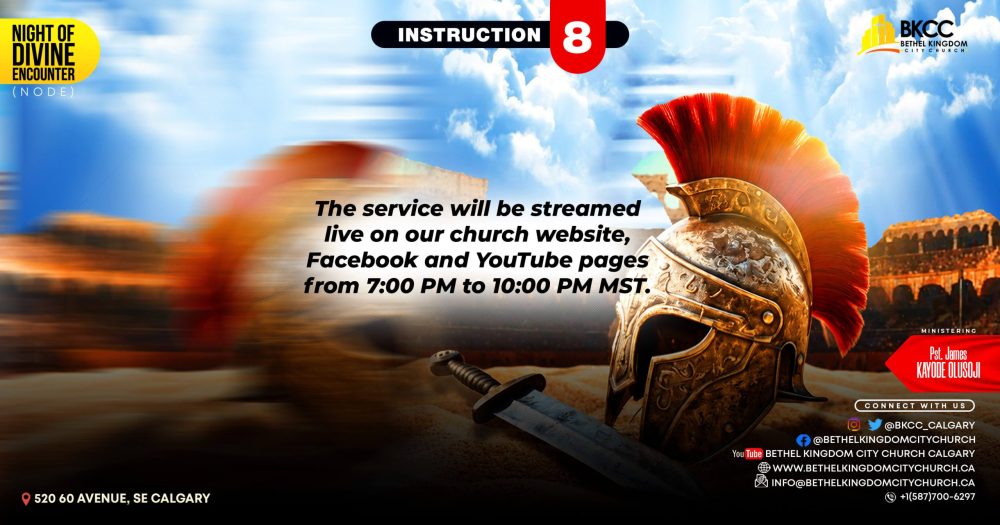
- Night of Divine Encounter: Participate online or in person on Friday, November 5th, 2026 from 7:00 PM to 10:00 PM MST. We will hold our physical meeting at:
520 60 Avenue, SE, Calgary.
You can also stream live via our Church’s website, Facebook, Twitter, or YouTube channels.
Become Part of the BKCC Family:
- Interested in becoming a member? Fill out the “I’m New“ form on our website, and we’ll reach out to you.
- Ready to serve? Complete the “Volunteer“ form, and we’ll connect with you about opportunities.
- Want to support the work of God? Visit the “Give“ section of our website to learn how you can contribute.
- Share your testimony with us by emailing [email protected].
We look forward to connecting with you as we experience God’s divine presence together!
Check Out NODE Instructions:

Welcome to Bethel Kingdom City Church Online – Church Without Walls

No matter where you are in the world, you are invited to be part of a growing global community centered on faith, prayer, and the transforming power of Jesus Christ. Bethel Kingdom City Church Online is a place where boundaries disappear and hearts connect.
Join us as we fellowship, pray, and grow together—online, yet united in spirit.
How to Connect With Us:
-
📧 Email: [email protected]
-
📞 Phone/WhatsApp: +1 (587) 700-6297
-
🌐 New Here? Simply fill out the “I’m New” form on our website
Whether you’re seeking prayer, community, or a deeper walk with Christ, there’s a place for you here.
All are welcome—come and experience Church Without Walls.
A Global Reach of 207 Countries in 2025 via BKCC Church’s Website

