

Upending Evil Administration at the Gates
Upending Evil Administration at the Gates
Upending evil administration at the gates refers to the spiritual or strategic act of dismantling, overturning, and removing corrupt systems of authority, influence, or control that operate at the metaphorical “gates” of a community, society, or individual life.
In biblical and spiritual contexts, “gates” represent places of authority, decision-making, and entry (such as city gates where elders and rulers sat in judgment). Therefore, an “evil administration at the gates” points to entrenched, hostile spiritual or systemic forces dictating culture, laws, or personal strongholds from positions of influence—and upending them means breaking their power to restore divine order and righteousness.
Understanding “Upending Evil Administration at the Gates”
Framing “Upending Evil Administration at the Gates” as a biblically grounded teaching does not suggest that every government or authority is inherently evil. Scripture consistently acknowledges legitimate human authority while simultaneously exposing rulers, officials, and systems that abused power, distorted justice, or actively opposed God’s purposes.
The imagery of the “gate” is central to this concept. In the biblical world, city gates served as the primary centers for public administration, legal judgments, leadership decisions, commerce, and community affairs. Consequently, a gate serves as a rich biblical symbol representing:
- Authority & Leadership
- Government & Public Administration
- Judgment & Legal Proceedings
- Decision-Making & Policy
- Access, Influence, & Opportunity
- Community Affairs & Economic Activity
- Protection & Security
Therefore, when we pray about upending evil administration at the gates, our focus extends far beyond individuals. We are asking God to dismantle and overturn unjust decisions, corrupt systems, wicked counsel, oppressive structures, false accusations, unlawful restrictions, and every administrative framework that contradicts His righteousness.
At the same time, believers must exercise careful spiritual discernment. Scripture does not teach wholesale rebellion against human governance. Romans 13 outlines the legitimate role of governing authorities in maintaining public order and punishing wrongdoings, while Acts 5:29 establishes the eternal principle that obedience to God takes precedence whenever human mandates directly conflict with God’s commands. The objective is never rebellion for its own sake, but rather an unwavering stand for divine righteousness whenever human authority is subverted to promote injustice.
Upending Evil Administration: The Power of Righteousness at the Gates
Throughout Scripture, we see that leadership matters. Those who occupy positions of authority and influence can either establish righteousness, justice, and peace or facilitate corruption, idolatry, oppression, and injustice. In biblical language, the gate was often a place where leaders sat, judgments were made, decisions were taken, and the affairs of the community were administered.
This is why the Bible repeatedly calls God’s people to establish justice at the gate. Evil administration must not simply be tolerated; God’s people are called to stand for truth, righteousness, justice, and obedience to God.
Nebuchadnezzar: Standing Against Ungodly Decrees
One powerful example is found in the account of King Nebuchadnezzar in Daniel 3. The king erected a golden image and commanded everyone to bow down and worship it. His decree was contrary to the commandments of God.
Shadrach, Meshach, and Abed-Nego refused to obey the king’s command because their allegiance to God was greater than their allegiance to an ungodly decree.
They understood that there are times when obedience to God requires respectfully refusing to participate in what contradicts His Word.
As a result, they were thrown into the fiery furnace. Yet God did not abandon them. He preserved them in the fire, and Nebuchadnezzar eventually acknowledged the greatness of their God.
The lesson is profound: righteousness may be tested at the gates of authority, but God is able to sustain those who stand faithfully for Him.
Upending evil administration does not always begin with occupying the seat of power. Sometimes it begins with one person saying, “I will not compromise my obedience to God.”
Ahab and Jezebel: When Leadership Promotes Evil
The reign of Ahab and Jezebel provides another sobering example of evil administration.
Ahab promoted the worship of Baal, while Jezebel actively persecuted the prophets of the Lord. The administration of the kingdom became deeply entangled with idolatry, injustice, and persecution.
Yet God raised Elijah.
Elijah stood before Ahab and declared that there would be no rain except at his word. According to 1 Kings 17–18, the drought continued for about three and a half years. Eventually, Elijah confronted the prophets of Baal on Mount Carmel, and God demonstrated that He alone is God.
The prophets of Baal were subsequently executed according to the judgment described in the Mosaic covenant and the events recorded in 1 Kings 18.
But Elijah’s ministry did not end at Mount Carmel. God continued to work through prophetic succession and the anointing of Elisha and Jehu. Jehu would later execute judgment against the house of Ahab and destroy the organized worship of Baal in Israel, as recorded in 2 Kings 9–10.
The story demonstrates an important principle:
One person who refuses to compromise can become a prophetic voice against an entire culture of unrighteousness.
Elijah stood when others were silent. He confronted idolatry when it had become institutionalized. His courage helped create a turning point in Israel.
Therefore, when we speak about upending evil administration, we are not merely talking about political structures. We are talking about confronting the normalization of evil with the uncompromising truth of God’s Word.
Sodom and Gomorrah: When Sin Becomes Entrenched
The account of Sodom and Gomorrah demonstrates another dimension of divine judgment.
Genesis 18–19 describes cities characterized by grievous wickedness and moral corruption. Abraham interceded before God, asking whether the righteous would be destroyed with the wicked. God demonstrated His willingness to spare the city for the sake of the righteous, even though the city ultimately proved to be deeply corrupt.
The destruction of Sodom and Gomorrah came through divine judgment.
This account reminds us that God takes righteousness and wickedness seriously.
Proverbs 14:34 declares:
“Righteousness exalts a nation, but sin is a reproach to any people.”
Proverbs 11:10 similarly teaches:
“When it goes well with the righteous, the city rejoices; And when the wicked perish, there is shouting.”
The condition of leadership and the moral condition of a society therefore matter greatly.
Those who occupy positions of authority can influence the moral direction of families, institutions, communities, and nations. Leadership can either encourage righteousness or normalize wickedness.
Yet Sodom also teaches us something sobering: even when judgment comes upon a corrupt environment, individual righteousness does not necessarily mean that every earthly consequence disappears. Lot was delivered from the destruction, but his life was profoundly affected by what happened to his surroundings, and his wife tragically perished after disobeying the angel’s command.
Therefore, believers should not be casual about the moral direction of the society around them.
The Kings of Israel and Judah: Leadership Has Consequences
The books of Kings and Chronicles repeatedly demonstrate the relationship between leadership and national spiritual condition.
Again and again, Scripture records kings who either did what was right in the sight of the Lord or did evil in the sight of the Lord.
The repeated pattern teaches us that God does not ignore what happens at the gates.
When leaders promoted idolatry, injustice, and disobedience, the consequences eventually affected the nation. When leaders returned to God and removed idols, righteousness was restored to varying degrees.
This is why Deuteronomy 16:18–19 instructed Israel:
“You shall appoint judges and officers in all your gates… and they shall judge the people with just judgment.”
The gate was therefore not merely a physical entrance. It represented a place of authority, judgment, administration, and influence.
What happens at the gate eventually affects what happens in the city.
Solomon: A Good Beginning Is Not Enough
King Solomon provides a particularly important warning.
Solomon began his reign with remarkable wisdom. He asked God for wisdom rather than riches and built the temple of the Lord.
However, his later years reveal a tragic decline.
According to 1 Kings 11, Solomon loved many foreign women, and his wives turned his heart toward other gods. He built high places associated with their worship.
The issue was not simply the number of his wives and concubines; the deeper problem was that Solomon’s heart was turned away from exclusive devotion to the Lord.
As a consequence, God announced that the kingdom would be torn from his house, although the judgment was delayed in its fullest expression for David’s sake.
After Solomon’s death, the kingdom was divided during the reign of his son Rehoboam, with the northern tribes forming the kingdom of Israel while Judah remained under Davidic rule.
The lesson is sobering:
A righteous beginning does not guarantee a righteous ending.
We must continually guard the gates of our hearts.
Pharaoh: When Government Becomes an Instrument of Oppression
Pharaoh provides another example of evil administration.
The Israelites were subjected to harsh oppression in Egypt. Pharaoh ordered the killing of Hebrew male infants and imposed severe burdens upon the Israelites.
But the people cried out to God.
Exodus 2:23–25 tells us that God heard their groaning, remembered His covenant, and looked upon the children of Israel.
God subsequently raised Moses and confronted Pharaoh with the demand:
“Let My people go.”
Pharaoh repeatedly hardened his heart, and God sent a series of plagues upon Egypt. Eventually, Pharaoh’s army pursued Israel into the Red Sea and was destroyed.
The message is clear:
Oppression may appear powerful for a season, but it is never beyond the reach of God.
God hears the cry of the oppressed.
Therefore, believers should pray for those who are suffering under unjust systems and should use righteous means to defend truth, justice, mercy, and human dignity.
Israel’s Exile: When a Nation Refuses Correction
The prophetic books, particularly Jeremiah, provide another sobering lesson.
God repeatedly warned Judah about its idolatry, injustice, rebellion, and disobedience. Through His prophets, God called the nation to repentance and warned that continued rebellion would result in invasion and exile.
But the people repeatedly refused to listen.
Eventually, Jerusalem was conquered and many people were carried into Babylonian captivity.
The lesson is important:
God’s patience should never be mistaken for God’s approval.
When a society repeatedly rejects correction and embraces injustice, the consequences can become severe.
Yet even in judgment, God continued to speak through His prophets and promised restoration.
Eli: When a Spiritual Gatekeeper Fails to Act
Eli provides a personal lesson about leadership responsibility.
Eli was Israel’s high priest, while his sons, Hophni and Phinehas, served as priests. Scripture records serious misconduct by Eli’s sons.
Eli did rebuke them, but Scripture also presents him as failing to restrain them adequately.
God therefore announced judgment upon Eli’s household.
Eventually, Hophni and Phinehas died on the same day, the priestly leadership of Eli’s house was judged, and Samuel emerged as a significant prophetic leader in Israel.
The lesson is crucial for everyone occupying a position of spiritual authority:
Leadership is not merely about holding a position; it is about exercising righteous responsibility.
When evil is tolerated by those responsible for correction, the consequences can extend beyond the individuals committing the wrongdoing.
Saul: When Disobedience Corrupts Leadership
King Saul provides another example.
God gave Saul specific instructions concerning the Amalekites, but Saul failed to obey those instructions completely. He spared Agag and kept what God had commanded him to destroy.
Samuel confronted him with the famous principle:
“To obey is better than sacrifice.”
— 1 Samuel 15:22
Saul’s disobedience ultimately resulted in the removal of his dynasty from God’s intended royal succession.
David was then chosen.
David was described as a man after God’s own heart—not because he was perfect, but because his relationship with God was characterized by faith and repentance.
Saul’s story reminds us that a position without obedience is dangerous.
God is concerned not merely with who occupies the gate, but with what that person does while sitting there.
Righteousness Can Influence the Gate
The examples throughout Scripture lead us to an important conclusion:
God cares about what happens at the gates.
He cares about who administers justice.
He cares about whether the vulnerable are protected.
He cares about whether truth is spoken.
He cares about whether leaders promote righteousness or facilitate wickedness.
He cares about whether His people remain silent when injustice becomes normalized.
Amos 5:15 says:
“Hate evil, love good; establish justice in the gate.”
This is a direct call to action.
Believers are not called to merely complain about darkness. We are called to live as light.
We are not called merely to identify injustice. We are called to practice righteousness.
We are not called merely to criticize corrupt leadership. We are called to be people of integrity who can be trusted when God gives us influence.
How Do We Upend Evil Administration?
Biblically, we do not overcome evil by becoming evil ourselves.
We overcome evil by standing firmly in righteousness.
1. Through Prayer
We pray for leaders and authorities.
1 Timothy 2:1–2 calls believers to pray for kings and all who are in authority.
Prayer invites God into the affairs of the gate.
2. Through Righteous Living
Our lives must demonstrate the alternative to the evil we oppose.
Jesus said:
“You are the light of the world.”
— Matthew 5:14
Darkness is challenged when light shines.
3. Through Truth
Zechariah 8:16 says:
“Speak each man the truth to his neighbor; give judgment in your gates for truth, justice, and peace.”
Truth must have a voice at the gate.
4. Through Courage
Shadrach, Meshach, and Abed-Nego refused to bow.
Elijah stood before Ahab.
Moses stood before Pharaoh.
Nathan confronted David.
John the Baptist confronted Herod.
Righteousness requires courage.
5. Through Godly Influence
Joseph influenced Egypt.
Daniel served with distinction in Babylon.
Esther used her position to intervene for her people.
Nehemiah used his position to rebuild Jerusalem.
God can position righteous people inside systems of influence so that they can advance justice and protect others.
6. Through Obedience
We cannot successfully confront evil outside while tolerating disobedience within.
The first gate God wants to govern is the gate of our own hearts.
7. Through Justice and Mercy
Micah 6:8 says:
“He has shown you, O man, what is good; And what does the Lord require of you But to do justly, To love mercy, And to walk humbly with your God?”
8. Through Peaceful and Lawful Action
Biblical righteousness does not require believers to become violent or lawless.
We can speak truth, advocate for justice, protect the vulnerable, hold leaders accountable, participate responsibly in society, serve our communities, and use legitimate institutions to challenge wrongdoing.
One Person Can Make a Difference
One of the most encouraging themes in Scripture is that God repeatedly used individuals who were willing to stand.
Joseph stood in Egypt.
Moses stood before Pharaoh.
Daniel stood in Babylon.
Esther stood before the king.
Nehemiah stood for Jerusalem.
Elijah stood before Ahab.
John the Baptist spoke truth to Herod.
Shadrach, Meshach, and Abed-Nego stood before Nebuchadnezzar.
These individuals did not necessarily possess the greatest earthly power.
But they possessed something more important:
Conviction.
They knew whom they served.
They knew what they believed.
And they refused to allow the pressure of their environment to determine their obedience to God.
Our Responsibility at the Gates
The responsibility of the believer is therefore not simply to pray, “Lord, remove every evil leader.”
Our prayer should also be:
“Lord, make me a righteous person whom You can trust at the gate.”
If God gives us influence, may we use it for justice.
If God gives us leadership, may we lead with integrity.
If God gives us a platform, may we speak truth.
If God gives us resources, may we defend the vulnerable.
If God gives us authority, may we serve rather than exploit.
If God gives us opportunity, may we advance righteousness.
And if we find ourselves under an administration that promotes injustice, may God give us wisdom and courage to stand for what is right without becoming part of the evil we oppose.
“IF MY PEOPLE…”
One of the clearest passages concerning the responsibility of God’s people is 2 Chronicles 7:14:
“If My people who are called by My name will humble themselves, and pray and seek My face, and turn from their wicked ways, then I will hear from heaven, and will forgive their sin and heal their land.”
Notice that God begins with His people.
Before asking God to change the nation, the Church must allow God to change the Church.
Before asking God to cleanse the gates, we must allow Him to cleanse our hearts.
Before asking for righteous leaders, we must become righteous people.
Before asking for justice in society, we must practice justice in our own spheres of influence.
Before asking God to overthrow evil administration, we must ask Him to overthrow every form of evil administration within us.
Conclusion: Let Righteousness Take the Gate
The Bible gives us repeated evidence that God cares about leadership, justice, righteousness, and the spiritual condition of societies.
Nebuchadnezzar’s decree was challenged by three faithful Hebrews.
Ahab and Jezebel’s idolatrous administration was confronted by Elijah and eventually judged.
Pharaoh’s oppression was broken by God’s intervention through Moses.
Sodom and Gomorrah were judged for their grievous wickedness.
Israel and Judah experienced the consequences of persistent rebellion.
Eli’s household was judged because of the failure of spiritual leadership.
Saul lost his throne because of disobedience.
These accounts remind us that evil may occupy the gate, but it does not own the gate.
God remains sovereign.
Therefore, our assignment is clear:
Pray at the gate.
Stand at the gate.
Speak truth at the gate.
Establish justice at the gate.
Live righteously at the gate.
Raise righteous people at the gate.
And refuse to surrender the gate to evil.
For Scripture says:
“Hate evil, love good; establish justice in the gate.” — Amos 5:15
And when God’s people humble themselves, pray, seek His face, and turn from their wicked ways, God promises to hear from heaven, forgive sin, and heal the land.
The transformation of a nation can begin with the righteousness of one person who refuses to compromise.
Prayer Points About Upending Evil Administration at the Gates
- Father, arise in Your sovereignty and take Your place over every gate where decisions concerning my life, family, church, community, career, finances, and destiny are being made. Let every unjust judgment and wicked administration at these gates come under Your divine scrutiny, in Jesus’ name. Father, expose and overturn every unjust judgment being issued against me, my family, and everything You have committed into my hands. Where decisions have been influenced by injustice, partiality, corruption, or wickedness, let righteousness prevail, in Jesus’ name.
Declare:
The Lord stands in the congregation of the mighty; therefore, no evil administration shall have the final word over my destiny.
Psalm 82:1–2 (NKJV)
“God stands in the congregation of the mighty; He judges among the gods. How long will you judge unjustly, and show partiality to the wicked?”
2. Father, uproot every system of partiality, bribery, corruption, manipulation, and perversion of justice operating at the gates concerning me. Let every decision that should favor righteousness no longer be controlled by corrupt influences, in Jesus’ name. Every influence that attempts to distort justice through money, gifts, favors, connections, manipulation, or personal interest, be exposed and rendered powerless. Let righteousness not be for sale at any gate connected to my destiny.
Deuteronomy 16:18–19 (NKJV)
“You shall appoint judges and officers in all your gates, which the Lord your God gives you, according to your tribes, and they shall judge the people with just judgment. 19 You shall not pervert justice; you shall not show partiality, nor take a bribe, for a bribe blinds the eyes of the wise and twists the words of the righteous.“
3. Father, strengthen everyone who speaks truth and righteousness at the gates. Let those who hate correction and oppose truth lose their ability to silence righteous voices. Let truth prevail over intimidation, manipulation, and false accusations.
Amos 5:10 (NKJV)
“They hate the one who rebukes in the gate, and they abhor the one who speaks uprightly.”
4. Father, establish justice at every gate connected to my life. Let evil be rejected and righteousness be established. Let decisions concerning me be governed by truth, justice, mercy, and righteousness, in Jesus’ name.
Amos 5:15 (NKJV)
“Hate evil, love good; establish justice in the gate. It may be that the Lord God of Hosts will be gracious to the remnant of Joseph.”
5. Lord, arise as the Defender of the oppressed. Wherever the vulnerable are being exploited, cheated, silenced, or denied justice at the gates, intervene on their behalf. Let every hand that oppresses the helpless be restrained, and let justice prevail. Father, plead the cause of everyone who has been unjustly treated, falsely accused, oppressed, or denied justice. Let Heaven answer on their behalf and let every unjust case receive divine intervention, in Jesus’ name.
Proverbs 22:22–23 (NKJV)
“Do not rob the poor because he is poor, nor oppress the afflicted at the gate; for the Lord will plead their cause, and plunder the soul of those who plunder them.”
6. Father, destroy every evil scheme that makes the innocent appear guilty. Every trap set through false words, manipulated evidence, false accusations, or distorted narratives, let it be exposed and rendered powerless, in Jesus’ name. Every snare prepared for those who speak truth at the gate, let it fail. Every attempt to punish, silence, discredit, or intimidate righteous voices, let it be overturned by the Lord.
Isaiah 29:20–21 (NKJV)
“For the terrible one is brought to nothing, the scornful one is consumed, and all who watch for iniquity are cut off—who make a man an offender by a word, and lay a snare for him who reproves in the gate, and turn aside the just by empty words.”
7. Father, raise men and women of integrity who will occupy positions of influence and authority. Let righteous people have access to the gates where important decisions are made. Give them wisdom, courage, discernment, and integrity.
Job 29:7 (NKJV)
“When I went out to the gate by the city, when I took my seat in the open square.”
8. Father, establish righteous leaders among the elders at the gates. Let positions of influence be occupied by people who fear God, love truth, reject corruption, and administer justice with integrity.
Proverbs 31:23 (NKJV)
“Her husband is known in the gates, when he sits among the elders of the land.”
9. Father, silence every voice speaking evil, falsehood, accusation, and condemnation against me at the gates. Let malicious conversations, gossip, slander, and wicked counsel lose their influence, in Jesus’ name.
Psalm 69:12 (NKJV)
“Those who sit in the gate speak against me, and I am the song of the drunkards.”
10. Father, restore righteous order wherever leadership and institutions have collapsed. Restore godly counsel, responsible leadership, accountability, wisdom, and justice in families, churches, communities, workplaces, and society.
Lamentations 5:14 (NKJV)
“The elders have ceased gathering at the gate, and the young men from their music.”
11. Father, raise righteous voices at every gate. Let truth be spoken, justice be established, and peace prevail. Give Your people courage to speak truth without fear and wisdom to speak truth with grace. Father, restore truth, justice, and peace to every gate where there has been disorder, corruption, injustice, or wicked administration. Let righteous administration replace evil administration.
Zechariah 8:16 (NKJV)
“These are the things you shall do: Speak each man the truth to his neighbor; give judgment in your gates for truth, justice, and peace.”
12. Lord of Hosts, be my crown of glory and my source of strength. Give me the wisdom, courage, and spiritual strength necessary to stand when battles are being fought at the gates. Let every battle against Your purpose for my life be turned back, in Jesus’ name.
Isaiah 28:5–6 (NKJV)
“In that day the Lord of hosts will be for a crown of glory and a diadem of beauty to the remnant of His people, for a spirit of justice to him who sits in judgment, and for strength to those who turn back the battle at the gate.”
13. Father, give me strength to speak with my adversaries at the gate. Let me not be ashamed before those who oppose me. Give me wisdom, courage, favor, and righteous counsel whenever I must face opposition.
Psalm 127:5 (NKJV)
“Happy is the man who has his quiver full of them; they shall not be ashamed, but shall speak with their enemies in the gate.”
14. Every evil alliance between corrupt officials, wicked administrators, unjust judges, and those seeking personal gain at the gates, let your influence be broken. Let every conspiracy designed to frustrate righteousness be exposed and brought to nothing, in Jesus’ name.
Micah 7:3 (NKJV)
“That they may successfully do evil with both hands— The prince asks for gifts, the judge seeks a bribe, and the great man utters his evil desire; So they scheme together.”
15. Father, cause every authority to fulfill the righteous purpose of authority. Let those entrusted with leadership protect what is good and restrain what is evil. Where authority has been abused, bring correction and accountability.
Romans 13:3–4 (NKJV)
“For rulers are not a terror to good works, but to evil. Do you want to be unafraid of the authority? Do what is good, and you will have praise from the same. 4 For he is God’s minister to you for good. But if you do evil, be afraid; for he does not bear the sword in vain; for he is God’s minister, an avenger to execute wrath on him who practices evil.“
DECLARATIONS OVER THE GATES
- I declare that evil shall not have the final word at my gates.
- I declare that righteousness shall be established at my gates.
- I declare that truth shall prevail over falsehood.
- I declare that justice shall prevail over corruption.
- I declare that every ungodly conspiracy against God’s purpose shall fail.
- I declare that every false accusation shall be exposed.
- I declare that every trap set against righteousness shall be broken.
- I declare that God will raise righteous voices at the gates.
- I declare that God will give His people wisdom to navigate the gates.
- I declare that corrupt influences shall not determine my destiny.
- I declare that the Lord is my defender when I face opposition at the gates.
- I declare that God will establish truth, justice, and peace at my gates.
- I declare that righteous people shall have influence where decisions are made.
- I declare that every battle at the gate shall be turned back according to God’s will.
- I declare that the Lord will establish righteous administration where there has been injustice.
CORPORATE PRAYER
Father, in the name of Jesus, we come before You as the righteous Judge and sovereign Lord. According to Psalm 82, arise in the places where judgment is being administered and examine every system of injustice. Wherever there is partiality, bribery, oppression, manipulation, false accusation, wicked counsel, or corruption, let truth and righteousness prevail.
According to Amos 5:15, let evil be rejected and good be established. Let justice be established at the gates. According to Zechariah 8:16, let truth, justice, and peace govern every decision. According to Isaiah 28:6, give strength to those who turn back the battle at the gate.
Defend the oppressed, vindicate those who have been falsely accused, protect those who speak truth, and expose every hidden scheme against righteousness. Raise men and women of integrity in positions of authority. Let every gate connected to our lives come under Your divine order.
Where evil administration has operated, establish righteous administration. Where injustice has prevailed, establish justice. Where truth has been silenced, give truth a voice. Where the vulnerable have been oppressed, arise as their Defender. Where corruption has distorted judgment, let righteousness prevail.
Lord of Hosts, be our crown of glory and our strength. Turn back every battle that is contrary to Your purpose. Let Your kingdom principles of truth, righteousness, justice, mercy, and peace be established at the gates. In Jesus’ mighty name, Amen.
“O Lord, let justice run down like water and righteousness like a mighty stream at every gate connected to our lives, in Jesus’ name!”
Be a Part of the Night of Divine Encounter:
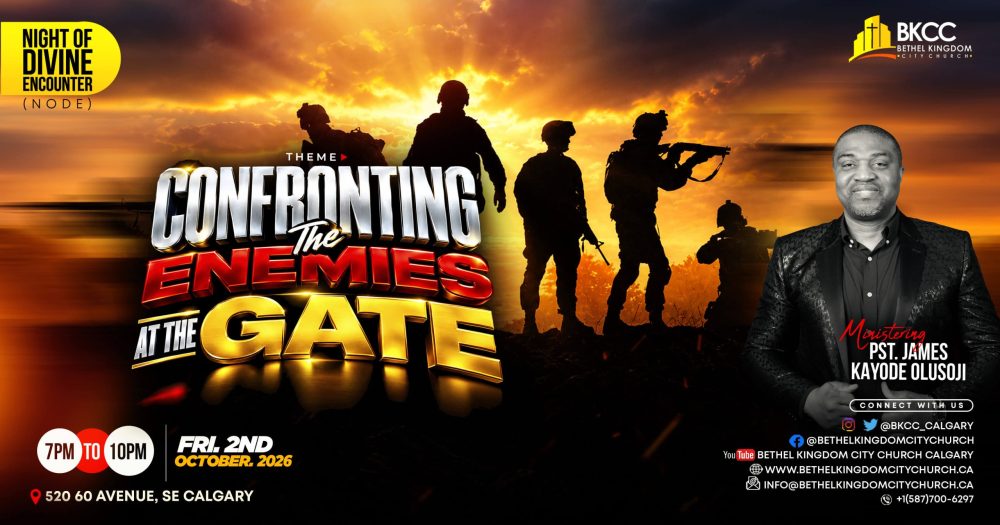
Join us for a transformative time of prayer and worship during our corporate prayer sessions:
- Early Morning Prayers: Stream live on our website daily from September 26th to October 2nd, 2026, between 5:00 AM and 6:00 AM MST.
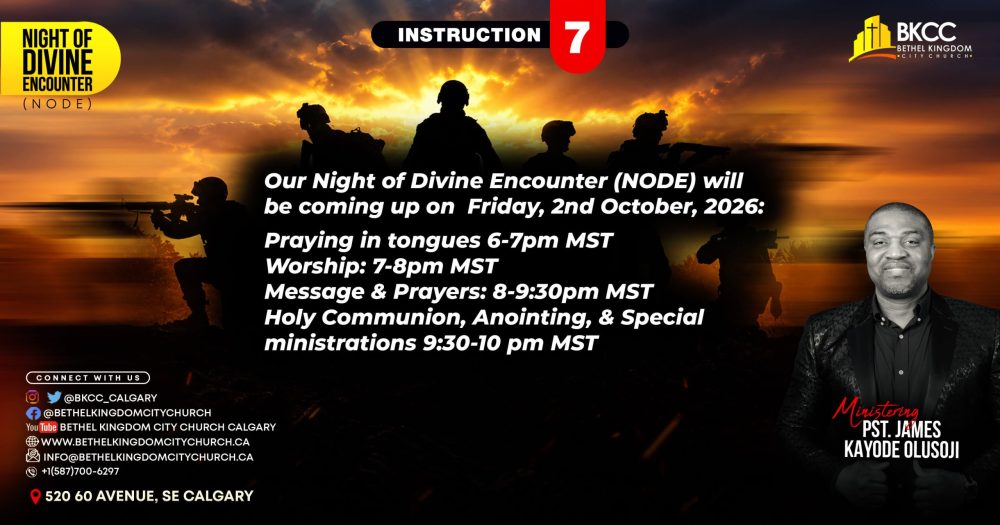
- Night of Divine Encounter: Participate online or in person on Friday, October 2nd, 2026 from 7:00 PM to 10:00 PM MST. We will hold our physical meeting at:
520 60 Avenue, SE, Calgary.
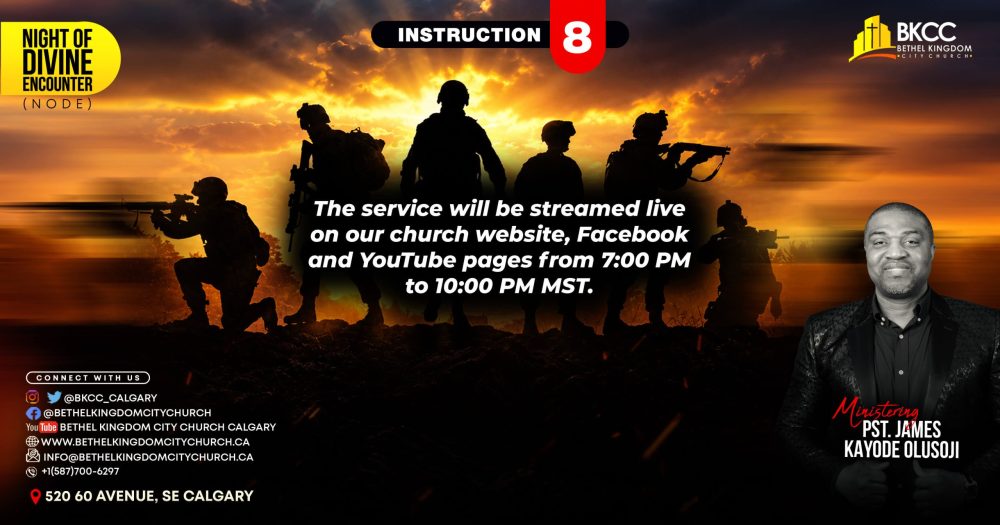
You can also stream live via our Church’s website, Facebook, Twitter, or YouTube channels.
Become Part of the BKCC Family:
- Interested in becoming a member? Fill out the “I’m New“ form on our website, and we’ll reach out to you.
- Ready to serve? Complete the “Volunteer“ form, and we’ll connect with you about opportunities.
- Want to support the work of God? Visit the “Give“ section of our website to learn how you can contribute.
- Share your testimony with us by emailing [email protected].
We look forward to connecting with you as we experience God’s divine presence together!
Check Out NODE Instructions:
Welcome to Bethel Kingdom City Church Online – Church Without Walls
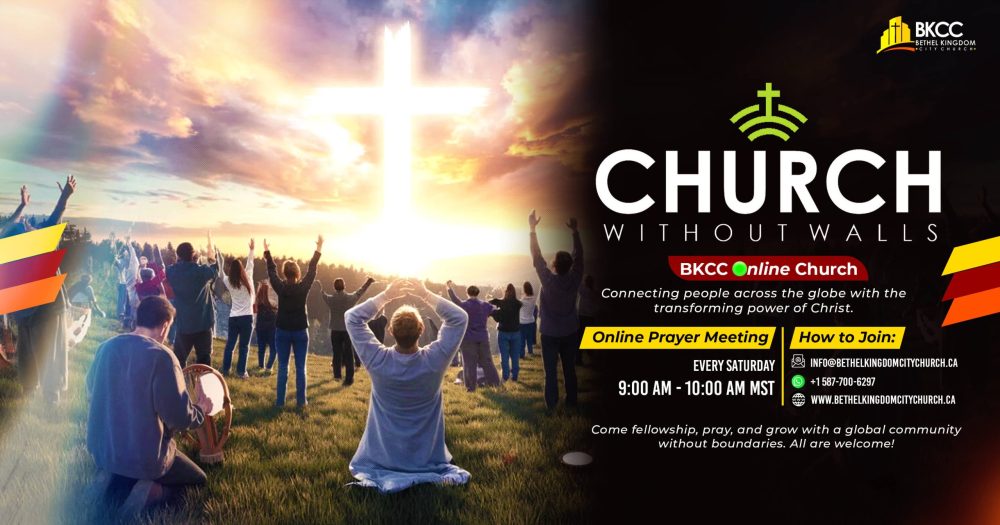
No matter where you are in the world, you are invited to be part of a growing global community centered on faith, prayer, and the transforming power of Jesus Christ. Bethel Kingdom City Church Online is a place where boundaries disappear and hearts connect.
Join us as we fellowship, pray, and grow together—online, yet united in spirit.
How to Connect With Us:
-
📧 Email: [email protected]
-
📞 Phone/WhatsApp: +1 (587) 700-6297
-
🌐 New Here? Simply fill out the “I’m New” form on our website
Whether you’re seeking prayer, community, or a deeper walk with Christ, there’s a place for you here.
All are welcome—come and experience Church Without Walls.
A Global Reach of 207 Countries in 2025 via BKCC Church’s Website

